砚 (yàn) means "Inkstone" in Chinese. It has 9 strokes with the radical 石.
Rated 4/5 in difficulty (challenging).
Appears in 3+ common words including 砚台 (yàn tāi), 笔砚 (bǐ yàn), 砚池 (yàn chí).
Due to its 9 strokes, Hanzi Writer's error detection shows 砚 requires focused practice — most learners need 10+ attempts for consistent accuracy.
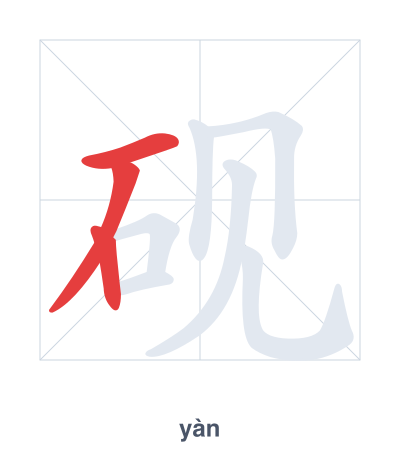
Open Hanzi Writer to see the animated stroke order and practice writing 砚 with real-time feedback.
The character 砚 (yàn) is written with 9 strokes. Follow the standard Chinese stroke order: top to bottom, left to right, outside before inside. The radical 石 is one of its key components.
Practice the correct stroke order with the Hanzi Writer app to see animated stroke-by-stroke guidance with real-time feedback.
砚 means Inkstone.
砚 is a compound character. The left radical 石 (stone) indicates the material, as inkstones were traditionally carved from stone. The right component 见 (see) provides a phonetic clue (yàn) and also hints at the inkstone's purpose—it is the surface on which one 'sees' the ink being ground for writing.
💡 Memory Tip: Picture a stone (石) with an eye (见) on it, watching over the ink as you grind it—the inkstone 'sees' your writing come to life.
爷爷有一块古老的砚台。
yé yé yǒu yī kuài gǔ lǎo de yàn tāi
Grandpa has an ancient inkstone.
书桌上摆放着笔砚。
shū zhuō shàng bǎi fàng zhuó bǐ yàn
Writing brushes and inkstones are placed on the desk.
砚池里的墨水干了。
yàn chí lǐ de mò shuǐ gàn le
The ink in the inkstone well has dried up.
Open Hanzi Writer to see the animated stroke order and practice writing 砚 with real-time feedback.
✨ Animated stroke order · Handwriting recognition · HSK-graded practice · Free to use
The character 砚 contains the radical 石 (stone) on the left, which shows that an inkstone is traditionally made from stone. The right side is 见 (see), which may suggest that you look at the inkstone while grinding ink or preparing to write.