悻 (xìng) means "angry; resentful" in Chinese. It has 11 strokes with the radical 忄.
Rated 4.2/5 in difficulty (advanced).
Appears in 3+ common words including 悻悻 (xìng xìng), 悻然 (xìng rán), 悻悻然 (xìng xìng rán).
Due to its 11 strokes, Hanzi Writer's error detection shows 悻 requires focused practice — most learners need 10+ attempts for consistent accuracy.
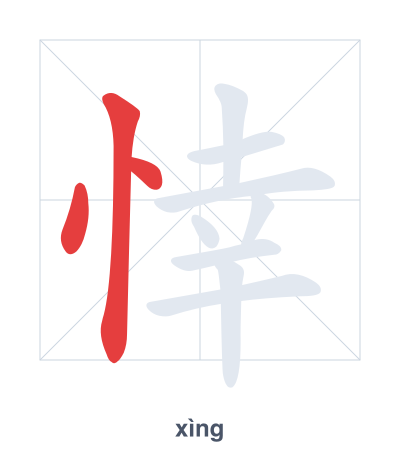
Open Hanzi Writer to see the animated stroke order and practice writing 悻 with real-time feedback.
The character 悻 (xìng) is written with 11 strokes. Follow the standard Chinese stroke order: top to bottom, left to right, outside before inside. The radical 忄 is one of its key components.
Practice the correct stroke order with the Hanzi Writer app to see animated stroke-by-stroke guidance with real-time feedback.
悻 means angry; resentful.
悻 is a phono-semantic compound: the radical 忄 (heart) indicates an emotion, and 幸 (xìng, 'luck') provides the sound. The meaning 'angry, resentful' suggests a feeling that arises when one's luck turns bad.
💡 Memory Tip: Picture a lucky charm (幸) suddenly breaking, making the heart (忄) burn with angry resentment.
他悻悻地离开了。
tā xìng xìng dì lí kāi le
He left resentfully.
他悻然拒绝了要求。
tā xìng rán jù jué le yāo qiú
He angrily refused the request.
他悻悻然走出门外。
tā xìng xìng rán zǒu chū mén wài
He walked out the door resentfully.
Open Hanzi Writer to see the animated stroke order and practice writing 悻 with real-time feedback.
✨ Animated stroke order · Handwriting recognition · HSK-graded practice · Free to use
悻 has two parts: the left side 忄 (heart radical) and the right side 幸 (xìng, meaning 'luck' or 'fortune'). The heart radical shows the emotion is internal, while 幸 provides the sound. Together they suggest a feeling of resentment that arises when luck goes wrong.