渫 (xiè) means "To dredge or discharge" in Chinese. It has 12 strokes with the radical 氵.
Rated 4.2/5 in difficulty (advanced).
Appears in 3+ common words including 渫水 (xiè shuǐ), 疏渫 (shū xiè), 渫井 (xiè jǐng).
Due to its 12 strokes, Hanzi Writer's error detection shows 渫 requires focused practice — most learners need 10+ attempts for consistent accuracy.
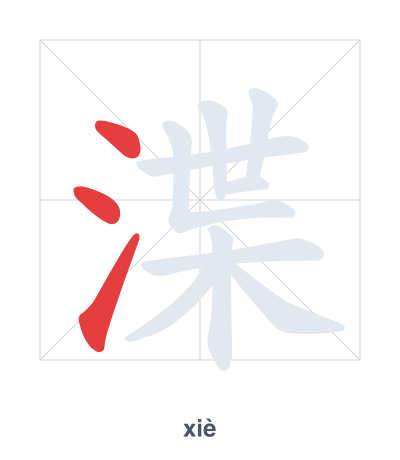
Open Hanzi Writer to see the animated stroke order and practice writing 渫 with real-time feedback.
The character 渫 (xiè) is written with 12 strokes. Follow the standard Chinese stroke order: top to bottom, left to right, outside before inside. The radical 氵 is one of its key components.
Practice the correct stroke order with the Hanzi Writer app to see animated stroke-by-stroke guidance with real-time feedback.
渫 means To dredge or discharge.
渫 is a phono-semantic compound. The water radical (氵) indicates its connection to liquids or waterways. The component 枼 (yè) originally depicted a leaf or thin slab, phonetically hints at the sound, and suggests the action of spreading or casting out, together meaning to dredge or discharge sediment from water.
💡 Memory Tip: Picture using a flat leaf (枼) like a scoop to remove muck from water (氵), clearing the channel with a 'scoot-away' motion.
渫水是一条河流。
xiè shuǐ shì yī tiáo hé liú
Xieshui is a river.
工人们在疏渫河道。
gōng rén men zài shū xiè hé dào
Workers are dredging the river channel.
我们要渫井了。
wǒ men yào xiè jǐng le
We need to dredge the well.
Open Hanzi Writer to see the animated stroke order and practice writing 渫 with real-time feedback.
✨ Animated stroke order · Handwriting recognition · HSK-graded practice · Free to use
渫 is made of the water radical 氵 on the left and the component 枼 (yè) on the right. 枼 originally meant a thin piece of wood or leaf, and combined with water it suggests the action of water moving through or clearing out debris. This structure directly points to the meaning "to dredge" or "to discharge."