楔 (xiē) means "wedge" in Chinese. It has 13 strokes with the radical 木.
Rated 4.2/5 in difficulty (advanced).
Appears in 3+ common words including 楔子 (xiē zi), 木楔 (mù xiē), 楔入 (xiē rù).
Due to its 13 strokes, Hanzi Writer's error detection shows 楔 requires focused practice — most learners need 10+ attempts for consistent accuracy.
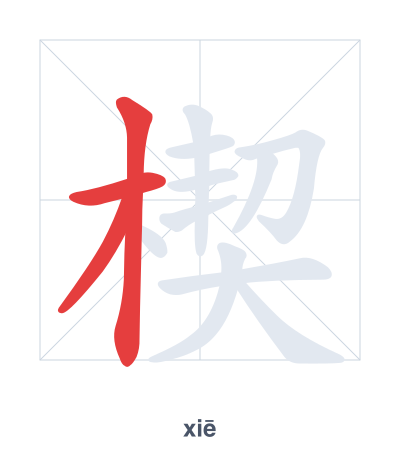
Open Hanzi Writer to see the animated stroke order and practice writing 楔 with real-time feedback.
The character 楔 (xiē) is written with 13 strokes. Follow the standard Chinese stroke order: top to bottom, left to right, outside before inside. The radical 木 is one of its key components.
Practice the correct stroke order with the Hanzi Writer app to see animated stroke-by-stroke guidance with real-time feedback.
楔 means wedge.
楔 is a phono-semantic compound: 木 (wood) indicates the material, and 契 (to carve) gives the sound and hints at the wedge's function of splitting wood. The right side 契 contains 刀 (knife), reinforcing the cutting action.
💡 Memory Tip: Picture a wooden wedge (木) driving into a carved contract (契) to split it apart.
他把楔子钉进木头里。
tā bǎ xiē zi dīng jìn mù tou lǐ
He hammered the wedge into the wood.
椅子腿松了,加个木楔。
yǐ zi tuǐ sōng le jiā gè mù xiē
The chair leg is loose; add a wooden wedge.
将木块楔入缝隙中。
jiāng mù kuài xiē rù fèng xì zhōng
Wedge the wooden block into the gap.
Open Hanzi Writer to see the animated stroke order and practice writing 楔 with real-time feedback.
✨ Animated stroke order · Handwriting recognition · HSK-graded practice · Free to use
楔 is made of the radical 木 (wood/tree) on the left and 契 (qì, meaning contract or engrave) on the right. Since a wedge is often made of wood, the 木 part hints at the material, while 契 provides the pronunciation and adds the idea of cutting or forcing in.