檄 (xí) means "official call to arms" in Chinese. It has 17 strokes with the radical 木.
Rated 4.2/5 in difficulty (advanced).
Appears in 3+ common words including 檄文 (xí wén), 传檄 (chuán xí), 讨檄 (tǎo xí).
Due to its 17 strokes, Hanzi Writer's error detection shows 檄 requires focused practice — most learners need 10+ attempts for consistent accuracy.
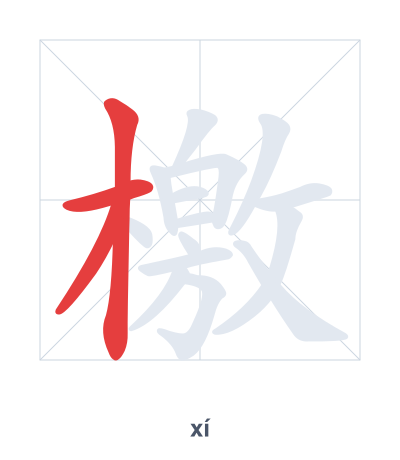
Open Hanzi Writer to see the animated stroke order and practice writing 檄 with real-time feedback.
The character 檄 (xí) is written with 17 strokes. Follow the standard Chinese stroke order: top to bottom, left to right, outside before inside. The radical 木 is one of its key components.
Practice the correct stroke order with the Hanzi Writer app to see animated stroke-by-stroke guidance with real-time feedback.
檄 means official call to arms.
檄 is a phono-semantic compound: the radical 木 (wood) suggests it was originally written on wooden tablets, while 敫 (a component meaning 'to shout' or 'make a loud sound') provides the pronunciation and hints at the urgent proclamation of a call to arms. In ancient China, such official orders were often carved on wooden slips and issued to mobilize troops.
💡 Memory Tip: Imagine a wooden sign (木) nailed to a tree, with a soldier screaming (敫) under it, urgently reading the call to arms to the villagers.
他写了一篇檄文。
tā xiě le yī piān xí wén
He wrote a call to arms.
传檄天下。
chuán xí tiān xià
To issue a proclamation to the whole world.
讨檄敌军。
tǎo xí dí jūn
Issue a call to arms against the enemy troops.
Open Hanzi Writer to see the animated stroke order and practice writing 檄 with real-time feedback.
✨ Animated stroke order · Handwriting recognition · HSK-graded practice · Free to use
The left side is the radical 木 (wood), which often appears in characters related to wooden objects. The right side is 敫 (jiǎo), which contributes the pronunciation and originally meant 'to beat' or 'to strike,' connecting to the idea of issuing a forceful proclamation.