蜗 (wō) means "snail (component)" in Chinese. It has 13 strokes with the radical 虫.
Rated 4.2/5 in difficulty (advanced).
Appears in 3+ common words including 蜗牛 (wō niú), 蜗居 (wō jū), 蜗壳 (wō ké).
Due to its 13 strokes, Hanzi Writer's error detection shows 蜗 requires focused practice — most learners need 10+ attempts for consistent accuracy.
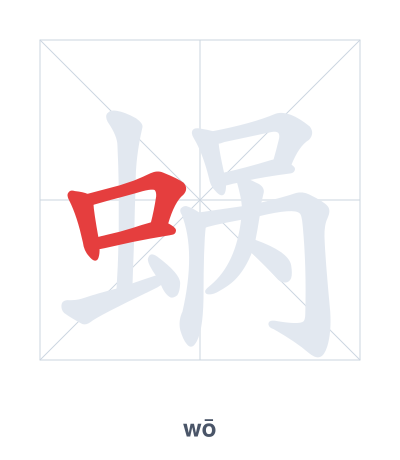
Open Hanzi Writer to see the animated stroke order and practice writing 蜗 with real-time feedback.
The character 蜗 (wō) is written with 13 strokes. Follow the standard Chinese stroke order: top to bottom, left to right, outside before inside. The radical 虫 is one of its key components.
Practice the correct stroke order with the Hanzi Writer app to see animated stroke-by-stroke guidance with real-time feedback.
蜗 means snail (component).
The character 蜗 combines the radical 虫 (insect/small creature) with the phonetic component 呙 (wō, suggesting a twisted or spiral shape). This reflects the snail's appearance as a small creature with a coiled shell. The ancient form was not pictographic; it is a compound character where 呙 provides both sound and a hint of the spiral form.
💡 Memory Tip: Imagine a snail saying 'Whoa!' as it slowly moves its spiral shell (呙) across an insect (虫) path.
蜗牛爬得很慢。
wō niú pá dé hěn màn
Snails crawl very slowly.
他在小城里蜗居。
tā zài xiǎo chéng lǐ wō jū
He lives in a cramped space in a small town.
蜗牛有坚硬的蜗壳。
wō niú yǒu jiān yìng de wō ké
Snails have hard shells.
Open Hanzi Writer to see the animated stroke order and practice writing 蜗 with real-time feedback.
✨ Animated stroke order · Handwriting recognition · HSK-graded practice · Free to use
蜗 is made of two parts: the radical 虫 (chong, meaning insect or small creature) and the phonetic component 呙 (wō, which hints at the pronunciation). Since a snail is a small animal with a shell, the 虫 radical fits well, while 呙 indicates how to say the character.