潍 (wéi) means "Wei (name of a river)" in Chinese. It has 14 strokes with the radical 氵.
Rated 4.2/5 in difficulty (advanced).
Appears in 3+ common words including 潍坊 (wéi fāng), 潍河 (wéi hé), 潍坊风筝 (wéi fāng fēng zhēng).
Due to its 14 strokes, Hanzi Writer's error detection shows 潍 requires focused practice — most learners need 10+ attempts for consistent accuracy.
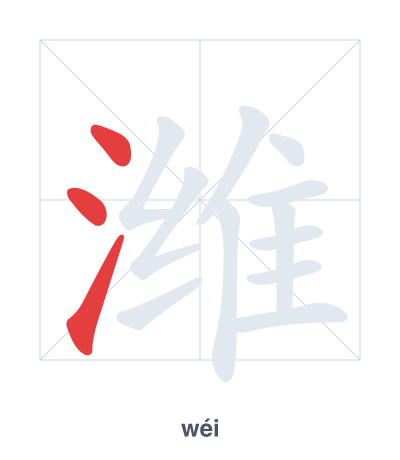
Open Hanzi Writer to see the animated stroke order and practice writing 潍 with real-time feedback.
The character 潍 (wéi) is written with 14 strokes. Follow the standard Chinese stroke order: top to bottom, left to right, outside before inside. The radical 氵 is one of its key components.
Practice the correct stroke order with the Hanzi Writer app to see animated stroke-by-stroke guidance with real-time feedback.
潍 means Wei (name of a river).
潍 is a phono-semantic compound. The radical 氵 indicates water, pointing to the Wei River, while the right component 維 (wéi) serves as a phonetic hint, though 維 itself means 'to tie' or 'silk cord'. Together, the character names the river in Shandong province.
💡 Memory Tip: Picture a river (氵) where a silk thread (纟) is used to tie a bird (隹) to a floating log—that's the Wei River.
他住在山东潍坊。
tā zhù zài shān dōng wéi fāng
He lives in Weifang, Shandong.
潍河的水很清。
wéi hé de shuǐ hěn qīng
The water in the Wei River is very clear.
潍坊风筝很有名。
wéi fāng fēng zhēng hěn yǒu míng
Weifang kites are very famous.
Open Hanzi Writer to see the animated stroke order and practice writing 潍 with real-time feedback.
✨ Animated stroke order · Handwriting recognition · HSK-graded practice · Free to use
潍 is made of the water radical 氵 on the left and the character 维 (wéi) on the right. The water radical shows that 潍 is a river name, while 维 provides the pronunciation wéi. Together they form the name of the Wei River.