煨 (wēi) means "to simmer; to stew over a slow fire" in Chinese. It has 13 strokes with the radical 火.
Rated 4.2/5 in difficulty (advanced).
Appears in 3+ common words including 煨汤 (wēi tāng), 煨肉 (wēi ròu), 煨熟 (wēi shú).
Due to its 13 strokes, Hanzi Writer's error detection shows 煨 requires focused practice — most learners need 10+ attempts for consistent accuracy.
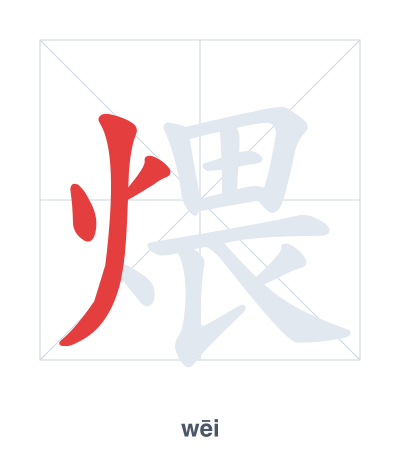
Open Hanzi Writer to see the animated stroke order and practice writing 煨 with real-time feedback.
The character 煨 (wēi) is written with 13 strokes. Follow the standard Chinese stroke order: top to bottom, left to right, outside before inside. The radical 火 is one of its key components.
Practice the correct stroke order with the Hanzi Writer app to see animated stroke-by-stroke guidance with real-time feedback.
煨 means to simmer; to stew over a slow fire.
煨 is a phono-semantic compound: the left radical 火 (fire) indicates cooking method, while the right component 畏 (wèi, 'fear') provides the pronunciation and metaphorically suggests the careful, cautious attention needed to slow-simmer food over a low flame.
💡 Memory Tip: Picture someone afraid (畏) of burning their soup, so they keep it over a tiny fire (火) and let it simmer gently—that's 煨.
妈妈在厨房里煨汤。
mā mā zài chú fáng lǐ wēi tāng
Mom is simmering soup in the kitchen.
这块肉要慢慢煨。
zhè kuài ròu yào màn màn wēi
This piece of meat needs to be simmered slowly.
土豆已经煨熟了。
tǔ dòu yǐ jīng wēi shú le
The potatoes have been roasted until cooked.
Open Hanzi Writer to see the animated stroke order and practice writing 煨 with real-time feedback.
✨ Animated stroke order · Handwriting recognition · HSK-graded practice · Free to use
The character 煨 consists of the radical 火 (fire) on the left, indicating heat or cooking, and the component 畏 on the right, which provides the pronunciation wēi. Together, they represent the idea of using slow fire to cook food, which matches the meaning "to simmer" or "to stew."