烃 (tīng) means "hydrocarbon" in Chinese. It has 9 strokes with the radical 火.
Rated 4/5 in difficulty (challenging).
Appears in 3+ common words including 烃类 (tīng lèi), 烷烃 (wán tīng), 芳烃 (fāng tīng).
Due to its 9 strokes, Hanzi Writer's error detection shows 烃 requires focused practice — most learners need 10+ attempts for consistent accuracy.
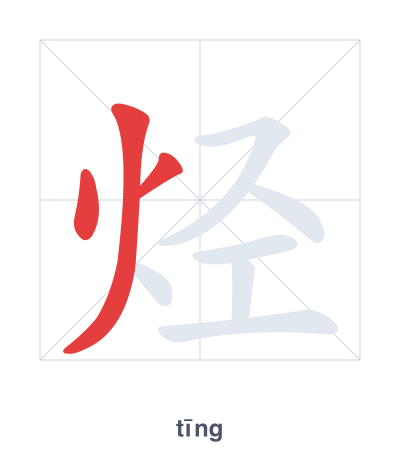
Open Hanzi Writer to see the animated stroke order and practice writing 烃 with real-time feedback.
The character 烃 (tīng) is written with 9 strokes. Follow the standard Chinese stroke order: top to bottom, left to right, outside before inside. The radical 火 is one of its key components.
Practice the correct stroke order with the Hanzi Writer app to see animated stroke-by-stroke guidance with real-time feedback.
烃 means hydrocarbon.
烃 is a modern compound character for hydrocarbon. The left radical 火 (fire) indicates that hydrocarbons burn readily, while the right component 巠 (tīng) serves as a phonetic hint and visually echoes the intertwining of carbon and hydrogen atoms (from 碳 tàn and 氢 qīng) in the molecule.
💡 Memory Tip: Picture the fire radical (火) igniting a chain of two carbon atoms (the 工 shapes inside 巠) linked by a hydrogen bond, forming a hydrocarbon in flames.
老师在讲烃类。
lǎo shī zài jiǎng tīng lèi
The teacher is teaching about hydrocarbons.
甲烷是一种烷烃。
jiǎ wán shì yī zhǒng wán tīng
Methane is an alkane.
芳烃有特殊的味道。
fāng tīng yǒu tè shū de wèi dào
Aromatic hydrocarbons have a special smell.
Open Hanzi Writer to see the animated stroke order and practice writing 烃 with real-time feedback.
✨ Animated stroke order · Handwriting recognition · HSK-graded practice · Free to use
烃 combines the radical 火 (fire/heat) on the left with 巠 (a phonetic component) on the right. The fire radical hints that hydrocarbons are often used as fuels that burn. The right side gives the pronunciation tīng, while the entire character means 'hydrocarbon' in chemistry.