佤 (wǎ) means "Wa (ethnic group)" in Chinese. It has 6 strokes with the radical 亻.
Rated 2.9/5 in difficulty (moderate).
Appears in 3+ common words including 佤族 (wǎ zú), 佤山 (wǎ shān), 佤语 (wǎ yǔ).
Hanzi Writer's stroke validation shows learners typically need 5-8 attempts to write 佤 with correct proportion and order.
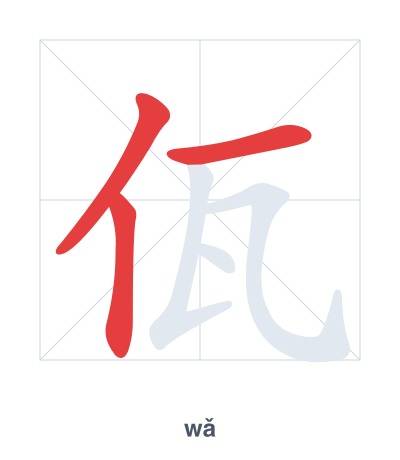
Open Hanzi Writer to see the animated stroke order and practice writing 佤 with real-time feedback.
The character 佤 (wǎ) is written with 6 strokes. Follow the standard Chinese stroke order: top to bottom, left to right, outside before inside. The radical 亻 is one of its key components.
Practice the correct stroke order with the Hanzi Writer app to see animated stroke-by-stroke guidance with real-time feedback.
佤 means Wa (ethnic group).
This character combines the person radical (亻) with the phonetic component 瓦 (wǎ, meaning 'tile'). It was created as a phonetic loan to represent the Wa ethnic group, using the sound of the tile character to write their name.
💡 Memory Tip: Picture a person (亻) balancing on a tiled roof (瓦) while waving a Wa ethnic flag.
佤族人很热情。
wǎ zú rén hěn rè qíng
The Wa people are very hospitable.
我们去佤山旅游。
wǒ men qù wǎ shān lǚ yóu
We are going to Wa Mountain for a trip.
佤语很好听。
wǎ yǔ hěn hǎo tīng
The Wa language sounds very pleasant.
Open Hanzi Writer to see the animated stroke order and practice writing 佤 with real-time feedback.
✨ Animated stroke order · Handwriting recognition · HSK-graded practice · Free to use
佤 is made of the radical 亻 (person) on the left and 瓦 (wǎ, tile) on the right. The radical signals that the character relates to people, while 瓦 provides the pronunciation. Together they specifically name the Wa ethnic group.