秕 (bǐ) means "blighted grain" in Chinese. It has 9 strokes with the radical 禾.
Rated 4/5 in difficulty (challenging).
Appears in 3+ common words including 秕谷 (bǐ gǔ), 秕子 (bǐ zi), 秕糠 (bǐ kāng).
Due to its 9 strokes, Hanzi Writer's error detection shows 秕 requires focused practice — most learners need 10+ attempts for consistent accuracy.
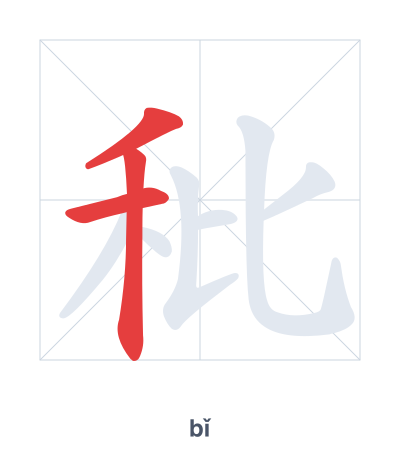
Open Hanzi Writer to see the animated stroke order and practice writing 秕 with real-time feedback.
The character 秕 (bǐ) is written with 9 strokes. Follow the standard Chinese stroke order: top to bottom, left to right, outside before inside. The radical 禾 is one of its key components.
Practice the correct stroke order with the Hanzi Writer app to see animated stroke-by-stroke guidance with real-time feedback.
秕 means blighted grain.
秕 combines the radical 禾 (grain) with 比 (compare), suggesting grain that is compared and found lacking. The phonetic component 比 also hints at emptiness (as in 秕 being hollow or blighted).
💡 Memory Tip: Picture a grain stalk (禾) with two empty husks (比) that produce only blighted, worthless seeds.
这里的秕谷很多。
zhè lǐ de bǐ gǔ hěn duō
There are many blighted grains here.
农民在选秕子。
nóng mín zài xuǎn bǐ zi
Farmers are sorting out the blighted grain.
这些秕糠可以喂鸡。
zhè xiē bǐ kāng kě yǐ wèi jī
This chaff can be used to feed chickens.
Open Hanzi Writer to see the animated stroke order and practice writing 秕 with real-time feedback.
✨ Animated stroke order · Handwriting recognition · HSK-graded practice · Free to use
秕 is composed of the radical 禾 (grain/plant) on the left and 比 (bǐ, compare) on the right. The radical indicates the character relates to grain, while 比 suggests something inferior or compared unfavorably, so together they mean blighted or empty grain.