萜 (tiē) means "terpene" in Chinese. It has 11 strokes with the radical 艹.
Rated 4.2/5 in difficulty (advanced).
Appears in 3+ common words including 萜烯 (tiē xī), 单萜 (dān tiē), 倍半萜 (bèi bàn tiē).
Due to its 11 strokes, Hanzi Writer's error detection shows 萜 requires focused practice — most learners need 10+ attempts for consistent accuracy.
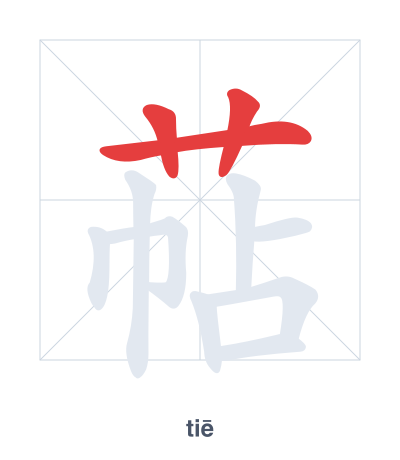
Open Hanzi Writer to see the animated stroke order and practice writing 萜 with real-time feedback.
The character 萜 (tiē) is written with 11 strokes. Follow the standard Chinese stroke order: top to bottom, left to right, outside before inside. The radical 艹 is one of its key components.
Practice the correct stroke order with the Hanzi Writer app to see animated stroke-by-stroke guidance with real-time feedback.
萜 means terpene.
萜 is a phono-semantic compound: the radical 艹 (grass/plant) indicates its relation to plant-derived organic compounds, and the phonetic component 帖 (tiē) provides the pronunciation. Terpenes are aromatic compounds found in many plants, such as pine resins and citrus oils.
💡 Memory Tip: Picture a sticky 'note' (帖) pinned to a plant (艹) that reads 'terpene,' reminding you that these aromatic compounds come from plants.
这种植物含有萜烯。
zhè zhòng zhí wù hán yǒu tiē xī
This plant contains terpenes.
单萜有特殊气味。
dān tiē yǒu tè shū qì wèi
Monoterpenes have a specific odor.
倍半萜是天然产物。
bèi bàn tiē shì tiān rán chǎn wù
Sesquiterpenes are natural products.
Open Hanzi Writer to see the animated stroke order and practice writing 萜 with real-time feedback.
✨ Animated stroke order · Handwriting recognition · HSK-graded practice · Free to use
萜 is made of the radical 艹 (grass) on top and the phonetic component 帖 (tiē) below. The 艹 radical signals it is related to plants or organic compounds, as terpenes are natural hydrocarbons found in many plants.