鳎 (tǎ) means "sole (fish)" in Chinese. It has 18 strokes with the radical 鱼.
Rated 4.2/5 in difficulty (advanced).
Appears in 3+ common words including 鳎目鱼 (tǎ mù yú), 鳎鱼 (tǎ yú), 鳎沙 (tǎ shā).
Due to its 18 strokes, Hanzi Writer's error detection shows 鳎 requires focused practice — most learners need 10+ attempts for consistent accuracy.
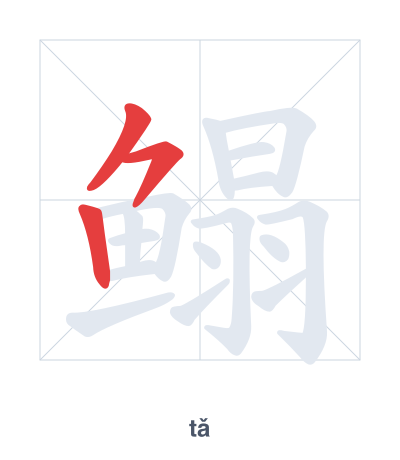
Open Hanzi Writer to see the animated stroke order and practice writing 鳎 with real-time feedback.
The character 鳎 (tǎ) is written with 18 strokes. Follow the standard Chinese stroke order: top to bottom, left to right, outside before inside. The radical 鱼 is one of its key components.
Practice the correct stroke order with the Hanzi Writer app to see animated stroke-by-stroke guidance with real-time feedback.
鳎 means sole (fish).
鳎 is a phono-semantic compound character. The radical 鱼 (fish) indicates its meaning relates to fish, while the component 沓 (tà) provides phonetic pronunciation and suggests a flat, overlapping shape—like a sole fish lying flat on the seafloor.
💡 Memory Tip: Imagine a flat fish (鱼) that looks like a stack (沓) of pancakes, flopping onto a plate for dinner.
妈妈今天买了鳎目鱼。
mā mā jīn tiān mǎi le tǎ mù yú
Mom bought sole fish today.
这种鳎鱼的肉质很嫩。
zhè zhǒng tǎ yú de ròu zhì hěn nèn
The meat of this sole is very tender.
鳎沙是南方常见的鱼类。
tǎ shā shì nán fāng cháng jiàn de yú lèi
Tongue sole is a common fish in the south.
Open Hanzi Writer to see the animated stroke order and practice writing 鳎 with real-time feedback.
✨ Animated stroke order · Handwriting recognition · HSK-graded practice · Free to use
The character 鳎 is composed of the radical 鱼 (fish) on the left and the phonetic component 遝 (tǎ) on the right. The radical tells you that this character refers to a type of fish, while the right side gives the pronunciation tǎ and also hints at the flat shape of a sole fish.