椤 (luó) means "Tree fern" in Chinese. It has 12 strokes with the radical 木.
Rated 4.2/5 in difficulty (advanced).
Appears in 3+ common words including 桫椤 (suō luó), 椤木 (luó mù), 椤树 (luó shù).
Due to its 12 strokes, Hanzi Writer's error detection shows 椤 requires focused practice — most learners need 10+ attempts for consistent accuracy.
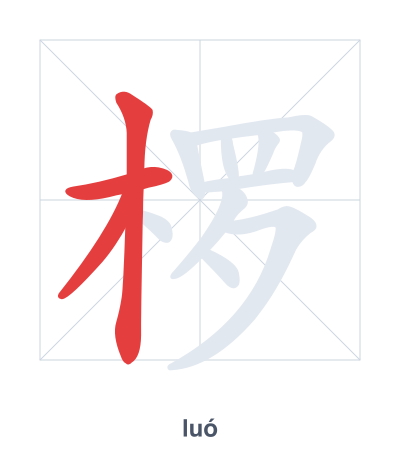
Open Hanzi Writer to see the animated stroke order and practice writing 椤 with real-time feedback.
The character 椤 (luó) is written with 12 strokes. Follow the standard Chinese stroke order: top to bottom, left to right, outside before inside. The radical 木 is one of its key components.
Practice the correct stroke order with the Hanzi Writer app to see animated stroke-by-stroke guidance with real-time feedback.
椤 means Tree fern.
椤 is a phono-semantic compound; the radical 木 (tree) indicates its connection to plants, while 罗 (luó, meaning net or gauze) hints at the net-like pattern of tree fern fronds.
💡 Memory Tip: Imagine a tree (木) wearing a net (罗) that looks like a giant fern frond.
桫椤是古老的植物。
suō luó shì gǔ lǎo de zhí wù
The tree fern is an ancient plant.
这种椤木非常坚硬。
zhè zhǒng luó mù fēi cháng jiān yìng
This Photinia wood is very hard.
山坡上长满了椤树。
shān pō shàng zhǎng mǎn le luó shù
The hillside is covered with tree ferns.
Open Hanzi Writer to see the animated stroke order and practice writing 椤 with real-time feedback.
✨ Animated stroke order · Handwriting recognition · HSK-graded practice · Free to use
The left side is the radical 木 (mù), meaning tree or wood, which tells you this character is related to a type of tree. The right side is 罗 (luó), which gives the pronunciation but also originally meant "net" — together, they suggest a tree with fern-like leaves, known as a tree fern.