穗 (suì) means "Ear of grain; tassel" in Chinese. It has 17 strokes with the radical 禾.
Rated 4.2/5 in difficulty (advanced).
Appears in 3+ common words including 麦穗 (mài suì), 稻穗 (dào suì), 穗子 (suì zi).
Due to its 17 strokes, Hanzi Writer's error detection shows 穗 requires focused practice — most learners need 10+ attempts for consistent accuracy.
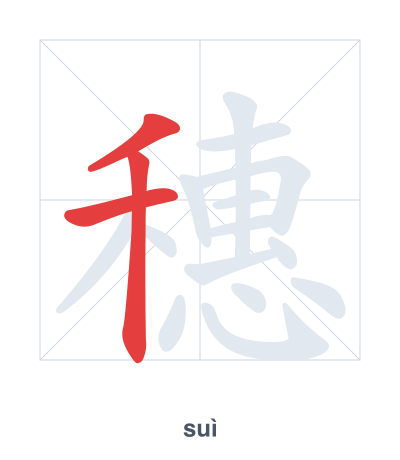
Open Hanzi Writer to see the animated stroke order and practice writing 穗 with real-time feedback.
The character 穗 (suì) is written with 17 strokes. Follow the standard Chinese stroke order: top to bottom, left to right, outside before inside. The radical 禾 is one of its key components.
Practice the correct stroke order with the Hanzi Writer app to see animated stroke-by-stroke guidance with real-time feedback.
穗 means Ear of grain; tassel.
穗 is a compound character: the left radical 禾 (grain) indicates the meaning of a cereal plant's fruiting head, while the right component 惠 (benefit/grace) may originally have served as a phonetic hint (though modern pronunciation differs) and also suggests the 'gift' of a ripe ear of grain.
💡 Memory Tip: Imagine a grain stalk (禾) topped with a tassel that looks like a tiny gift bow (惠) — the ear of grain is nature's present.
麦穗已经黄了。
mài suì yǐ jīng huáng le
The ears of wheat have turned yellow.
稻穗弯下了腰。
dào suì wān xià le yāo
The ears of rice are heavy and drooping.
衣服上有个穗子。
yī fú shàng yǒu gè suì zi
There is a tassel on the clothes.
Open Hanzi Writer to see the animated stroke order and practice writing 穗 with real-time feedback.
✨ Animated stroke order · Handwriting recognition · HSK-graded practice · Free to use
The left side is the radical 禾 (grain), which directly relates to the meaning of an ear of grain or tassel. The right side is 惠 (huì), which originally provided a phonetic hint, though the pronunciation has shifted over time. Together, they form a phono-semantic compound that refers to the seed-bearing part of grain plants.