涑 (sù) means "Su (name of a river)" in Chinese. It has 10 strokes with the radical 氵.
Rated 4.2/5 in difficulty (advanced).
Appears in 3+ common words including 涑水 (sù shuǐ), 涑河 (sù hé), 涑 (sù).
Due to its 10 strokes, Hanzi Writer's error detection shows 涑 requires focused practice — most learners need 10+ attempts for consistent accuracy.
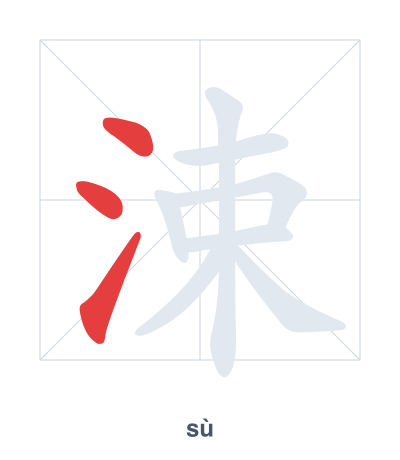
Open Hanzi Writer to see the animated stroke order and practice writing 涑 with real-time feedback.
The character 涑 (sù) is written with 10 strokes. Follow the standard Chinese stroke order: top to bottom, left to right, outside before inside. The radical 氵 is one of its key components.
Practice the correct stroke order with the Hanzi Writer app to see animated stroke-by-stroke guidance with real-time feedback.
涑 means Su (name of a river).
涑 is a phono-semantic compound. The radical 氵 (water) indicates it relates to a river, and 束 (shù, meaning 'to bind') provides the pronunciation. It specifically names the Su River in ancient China.
💡 Memory Tip: Picture a bundle of reeds (束) floating down a river (氵)—that's the Su River.
涑水是一条河的名字。
sù shuǐ shì yī tiáo hé de míng zì
Sushui is the name of a river.
我家住在涑河边。
wǒ jiā zhù zài sù hé biān
I live by the Su River.
涑字常用于地名。
sù zì cháng yòng yú dì míng
The character 'Su' is often used in place names.
Open Hanzi Writer to see the animated stroke order and practice writing 涑 with real-time feedback.
✨ Animated stroke order · Handwriting recognition · HSK-graded practice · Free to use
涑 is composed of the radical 氵 (water) on the left and the phonetic component 束 (shù) on the right. The radical indicates that the character relates to water, and 束 provides a clue to pronunciation. Together they form the name of a river, the Su River.