鸶 (sī) means "egret / heron" in Chinese. It has 10 strokes with the radical 鸟.
Rated 4.2/5 in difficulty (advanced).
Appears in 3+ common words including 鹭鸶 (lù sī), 白鹭鸶 (bái lù sī), 鸶鸟 (sī niǎo).
Due to its 10 strokes, Hanzi Writer's error detection shows 鸶 requires focused practice — most learners need 10+ attempts for consistent accuracy.
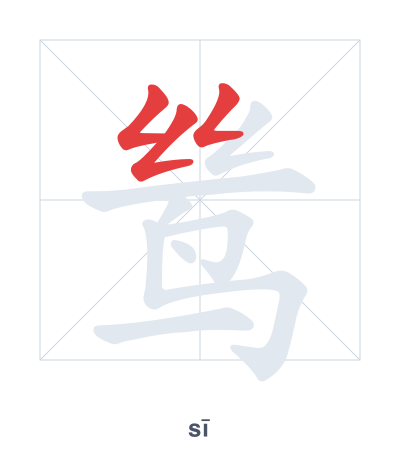
Open Hanzi Writer to see the animated stroke order and practice writing 鸶 with real-time feedback.
The character 鸶 (sī) is written with 10 strokes. Follow the standard Chinese stroke order: top to bottom, left to right, outside before inside. The radical 鸟 is one of its key components.
Practice the correct stroke order with the Hanzi Writer app to see animated stroke-by-stroke guidance with real-time feedback.
鸶 means egret / heron.
鸶 is a compound character combining the radical 鸟 (bird) with the phonetic component 丝 (sī, silk). The phonetic suggests pronunciation, while the bird radical indicates it is a type of heron or egret, known for its white, silk-like feathers.
💡 Memory Tip: Imagine a white egret (鸟) whose feathers are as delicate and pure as fine silk threads (丝).
鹭鸶在水边站着。
lù sī zài shuǐ biān zhàn zhe
The egret is standing by the water.
白鹭鸶的羽毛很白。
bái lù sī de yǔ máo hěn bái
The egret's feathers are very white.
这种鸶鸟很罕见。
zhè zhǒng sī niǎo hěn hǎn jiàn
This kind of egret is very rare.
Open Hanzi Writer to see the animated stroke order and practice writing 鸶 with real-time feedback.
✨ Animated stroke order · Handwriting recognition · HSK-graded practice · Free to use
The character 鸶 is made of two parts: the top is 丝 (silk, pronounced sī) and the bottom is 鸟 (bird). The top part gives the sound, while the bottom part shows the meaning, because an egret or heron is a type of bird. So 鸶 means a bird with a name that sounds like "sī."