吮 (shǔn) means "to suck" in Chinese. It has 7 strokes with the radical 口.
Rated 3.5/5 in difficulty (challenging).
Appears in 3+ common words including 吮吸 (shǔn xī), 吮指 (shǔn zhǐ), 吮手指 (shǔn shǒu zhǐ).
Due to its 7 strokes, Hanzi Writer's error detection shows 吮 requires focused practice — most learners need 10+ attempts for consistent accuracy.
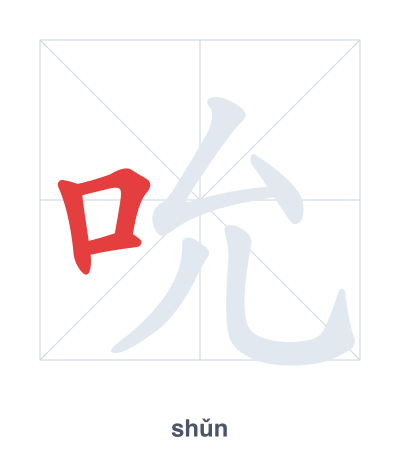
Open Hanzi Writer to see the animated stroke order and practice writing 吮 with real-time feedback.
The character 吮 (shǔn) is written with 7 strokes. Follow the standard Chinese stroke order: top to bottom, left to right, outside before inside. The radical 口 is one of its key components.
Practice the correct stroke order with the Hanzi Writer app to see animated stroke-by-stroke guidance with real-time feedback.
吮 means to suck.
This character is a phono-semantic compound. The left radical 口 (mouth) indicates the action involves the mouth, while the right component 允 (yǔn) contributes the pronunciation and originally meant 'to allow' or 'sincere'—here it hints at the sound or motion of sucking something in.
💡 Memory Tip: Imagine a mouth (口) sucking up a long, wiggly noodle that curves like the shape of 允 (yǔn) on the right.
蜜蜂在吮吸花蜜。
mì fēng zài shǔn xī huā mì
The bee is sucking nectar.
那个小孩在吮指。
nà ge xiǎo hái zài shǔn zhǐ
That child is sucking their thumb.
别让孩子吮手指。
bié ràng hái zi shǔn shǒu zhǐ
Don't let the child suck their fingers.
Open Hanzi Writer to see the animated stroke order and practice writing 吮 with real-time feedback.
✨ Animated stroke order · Handwriting recognition · HSK-graded practice · Free to use
吮 combines the radical 口 (mouth) on the left with 允 (yǔn, to allow) on the right. The mouth radical directly relates to the meaning "to suck," as sucking is an action done with the mouth. The right side 允 provides pronunciation (shǔn) and adds no specific meaning, but the whole character visually suggests the mouth performing a sucking action.