菽 (shū) means "beans; legumes" in Chinese. It has 11 strokes with the radical 艹.
Rated 4.2/5 in difficulty (advanced).
Appears in 3+ common words including 豆菽 (dòu shū), 菽粟 (shū sù), 采菽 (cǎi shū).
Due to its 11 strokes, Hanzi Writer's error detection shows 菽 requires focused practice — most learners need 10+ attempts for consistent accuracy.
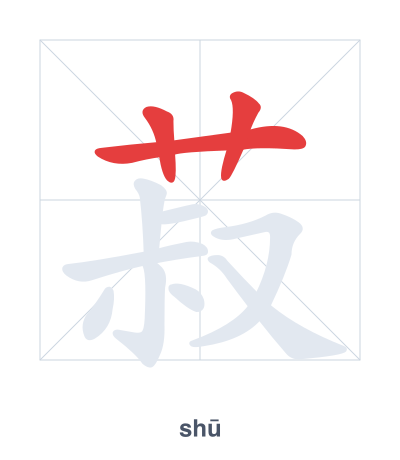
Open Hanzi Writer to see the animated stroke order and practice writing 菽 with real-time feedback.
The character 菽 (shū) is written with 11 strokes. Follow the standard Chinese stroke order: top to bottom, left to right, outside before inside. The radical 艹 is one of its key components.
Practice the correct stroke order with the Hanzi Writer app to see animated stroke-by-stroke guidance with real-time feedback.
菽 means beans; legumes.
菽 is a compound character with the 'grass' radical (艹) indicating it's a plant, and the phonetic component 叔 (shū) providing the sound. Ancient Chinese classified legumes like beans under this character, which appears in classical texts as a staple crop. The top grass radical visually signals it's a herbaceous plant, while 叔, originally meaning 'uncle,' adds a mnemonic hook for the pronunciation.
💡 Memory Tip: Picture your uncle (叔) kneeling in a grassy field (艹), proudly harvesting a big pile of beans (菽).
农民在种豆菽。
nóng mín zài zhǒng dòu shū
Farmers are planting beans and pulses.
菽粟是重要的粮食。
shū sù shì zhòng yào de liáng shí
Beans and grain are important food crops.
大家一起去采菽。
dà jiā yì qǐ qù cǎi shū
Everyone went to pick beans together.
Open Hanzi Writer to see the animated stroke order and practice writing 菽 with real-time feedback.
✨ Animated stroke order · Handwriting recognition · HSK-graded practice · Free to use
The character 菽 has the radical 艹 (grass, herb) on top, which indicates it is a plant. Below is 叔 (shū), which provides pronunciation and also adds the idea of a younger uncle. Together, the structure means a legume plant — beans growing under grass.