鳋 (sāo) means "parasitic copepod" in Chinese. It has 17 strokes with the radical 鱼.
Rated 4.2/5 in difficulty (advanced).
Appears in 3+ common words including 鱼鳋 (yú sāo), 鳋病 (sāo bìng), 鳋类 (sāo lèi).
Due to its 17 strokes, Hanzi Writer's error detection shows 鳋 requires focused practice — most learners need 10+ attempts for consistent accuracy.
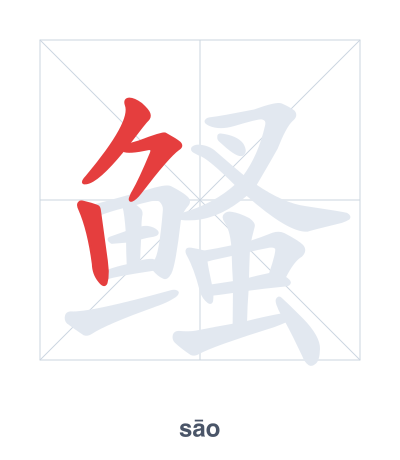
Open Hanzi Writer to see the animated stroke order and practice writing 鳋 with real-time feedback.
The character 鳋 (sāo) is written with 17 strokes. Follow the standard Chinese stroke order: top to bottom, left to right, outside before inside. The radical 鱼 is one of its key components.
Practice the correct stroke order with the Hanzi Writer app to see animated stroke-by-stroke guidance with real-time feedback.
鳋 means parasitic copepod.
This compound character combines the radical 鱼 (fish) with 蚤 (flea/louse), indicating a fish parasite that behaves like a flea. The left side shows it's an aquatic creature, while the right side conveys the idea of a tiny, irritating pest clinging to the host.
💡 Memory Tip: Imagine a fish (鱼) scratching its scales because a flea (蚤) is biting it — that's the parasitic copepod 鳋 (sāo) making it itch!
鱼身上长了鱼鳋。
yú shēn shàng zhǎng le yú sāo
The fish has fish lice on its body.
这种鱼容易得鳋病。
zhè zhǒng yú róng yì dé sāo bìng
This kind of fish is prone to parasitic diseases.
鳋类是寄生虫。
sāo lèi shì jì shēng chóng
Ergasilids are parasites.
Open Hanzi Writer to see the animated stroke order and practice writing 鳋 with real-time feedback.
✨ Animated stroke order · Handwriting recognition · HSK-graded practice · Free to use
鳋 is composed of the radical 鱼 (fish) on the left, which indicates the meaning relates to fish, and the component 蚤 (flea) on the right, which suggests a small parasite. Together, 鳋 refers to a parasitic copepod that lives on fish, like a fish flea. The structure directly combines 'fish' and 'flea' to form the word for fish lice.