鳃 (sāi) means "gill" in Chinese. It has 17 strokes with the radical 鱼.
Rated 4.2/5 in difficulty (advanced).
Appears in 3+ common words including 鱼鳃 (yú sāi), 鳃部 (sāi bù), 鳃盖 (sāi gài).
Due to its 17 strokes, Hanzi Writer's error detection shows 鳃 requires focused practice — most learners need 10+ attempts for consistent accuracy.
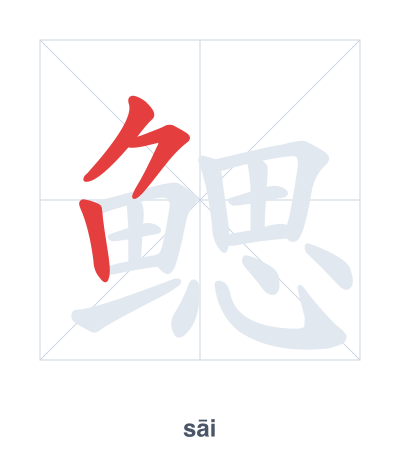
Open Hanzi Writer to see the animated stroke order and practice writing 鳃 with real-time feedback.
The character 鳃 (sāi) is written with 17 strokes. Follow the standard Chinese stroke order: top to bottom, left to right, outside before inside. The radical 鱼 is one of its key components.
Practice the correct stroke order with the Hanzi Writer app to see animated stroke-by-stroke guidance with real-time feedback.
鳃 means gill.
鳃 is a phono-semantic compound combining the radical 鱼 (fish) and the phonetic component 思 (sī). The fish radical indicates the meaning relates to fish anatomy, while 思 provides the pronunciation. Gills are the respiratory organs of fish, visible on the sides of the head.
💡 Memory Tip: Imagine a fish (鱼) using its gills to 'think' (思) about how to breathe underwater.
鱼用鱼鳃呼吸。
yú yòng yú sāi hū xī
Fish breathe through their gills.
鱼的鳃部是红色的。
yú de sāi bù shì hóng sè de
The fish's gills are red.
鳃盖保护着鱼鳃。
sāi gài bǎo hù zhe yú sāi
The gill cover protects the gills.
Open Hanzi Writer to see the animated stroke order and practice writing 鳃 with real-time feedback.
✨ Animated stroke order · Handwriting recognition · HSK-graded practice · Free to use
The character 鳃 is made of the radical 鱼 on the left, which means "fish," indicating the meaning is related to fish. The right part is 思, which usually means "to think," but here it provides a phonetic clue for the pronunciation sāi, although the tones differ.