薷 (rú) means "Elsholtzia (a type of herb)" in Chinese. It has 17 strokes with the radical 艹.
Rated 4.2/5 in difficulty (advanced).
Appears in 3+ common words including 香薷 (xiāng rú), 香薷饮 (xiāng rú yǐn), 木薷 (mù rú).
Due to its 17 strokes, Hanzi Writer's error detection shows 薷 requires focused practice — most learners need 10+ attempts for consistent accuracy.
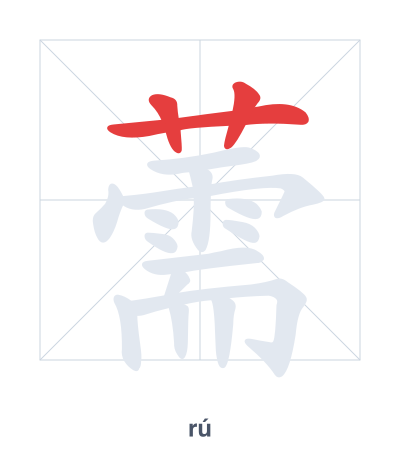
Open Hanzi Writer to see the animated stroke order and practice writing 薷 with real-time feedback.
The character 薷 (rú) is written with 17 strokes. Follow the standard Chinese stroke order: top to bottom, left to right, outside before inside. The radical 艹 is one of its key components.
Practice the correct stroke order with the Hanzi Writer app to see animated stroke-by-stroke guidance with real-time feedback.
薷 means Elsholtzia (a type of herb).
薷 is a phono-semantic compound: the radical 艹 (grass) indicates it is a type of herb, while 需 (xū, meaning 'need' or 'require') provides the pronunciation hint rú. The character thus associates the aromatic herb Elsholtzia with the idea of something 'needed' or 'required' in herbal medicine.
💡 Memory Tip: Imagine a thirsty herb (艹) that constantly needs (需) water, and you must run (rú sounds like 'rue') to fetch it.
香薷是一种中药材。
xiāng rú shì yī zhǒng zhōng yào cái
Elsholtzia is a type of Chinese herbal medicine.
夏天可以喝点香薷饮。
xià tiān kě yǐ hē diǎn xiāng rú yǐn
You can drink some Elsholtzia herbal tea in summer.
山坡上长满了木薷。
shān pō shàng zhǎng mǎn le mù rú
The hillside is covered with Elsholtzia.
Open Hanzi Writer to see the animated stroke order and practice writing 薷 with real-time feedback.
✨ Animated stroke order · Handwriting recognition · HSK-graded practice · Free to use
薷 is made of the radical 艹 (grass) on top and 需 (rú, meaning "need" but here phonetic) below. The grass radical signals it is a type of plant, specifically an herb. Together they suggest a grass-related plant called Elsholtzia.