冗 (rǒng) means "Redundant / superfluous" in Chinese. It has 4 strokes with the radical 冖, and is HSK Level 7.
Rated 2.4/5 in difficulty (moderate).
Harder than 2% of HSK Level 7 characters.
Appears in 3+ common words including 冗长 (rǒng cháng), 冗余 (rǒng yú), 拨冗 (bō rǒng).
Hanzi Writer's stroke validation shows learners typically need 5-8 attempts to write 冗 with correct proportion and order.
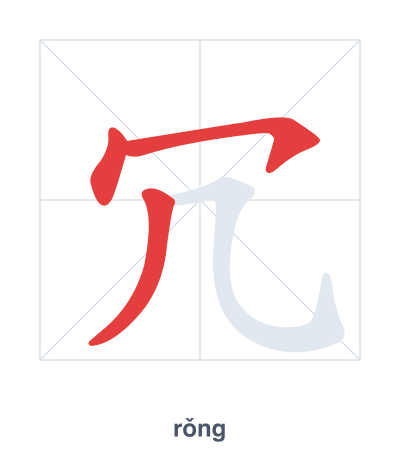
Open Hanzi Writer to see the animated stroke order and practice writing 冗 with real-time feedback.
The character 冗 (rǒng) is written with 4 strokes. Follow the standard Chinese stroke order: top to bottom, left to right, outside before inside. The radical 冖 is one of its key components.
Practice the correct stroke order with the Hanzi Writer app to see animated stroke-by-stroke guidance with real-time feedback.
冗 means Redundant / superfluous.
As an HSK Level 7 character, 冗 is an intermediate-level character.
Combines the radical 冖 (a covering or roof) and 人 (person), originally picturing a person idle under a roof, implying someone superfluous or redundant.
💡 Memory Tip: Picture a person (人) trapped under a low cover (冖), uselessly hanging around—totally redundant.
这个会议太冗长了。
zhè ge huì yì tài rǒng cháng le
This meeting is too long and tedious.
电脑里有很多冗余文件。
diàn nǎo lǐ yǒu hěn duō rǒng yú wén jiàn
There are many redundant files on the computer.
请您拨冗参加会议。
qǐng nín bō rǒng cān jiā huì yì
Please take the time to attend the meeting.
Open Hanzi Writer to see the animated stroke order and practice writing 冗 with real-time feedback.
✨ Animated stroke order · Handwriting recognition · HSK-graded practice · Free to use
The character 冗 has a roof radical (冖) on top, which originally meant a covering or shelter, and a simplified form of 人 (person) inside. This combination suggests a person under a cover, implying something extra or unnecessary, like a burden or redundancy.