桡 (ráo) means "Radius (bone) / Oar" in Chinese. It has 10 strokes with the radical 木.
Rated 4.2/5 in difficulty (advanced).
Appears in 3+ common words including 桡骨 (ráo gǔ), 桡动脉 (ráo dòng mài), 舟桡 (zhōu ráo).
Due to its 10 strokes, Hanzi Writer's error detection shows 桡 requires focused practice — most learners need 10+ attempts for consistent accuracy.
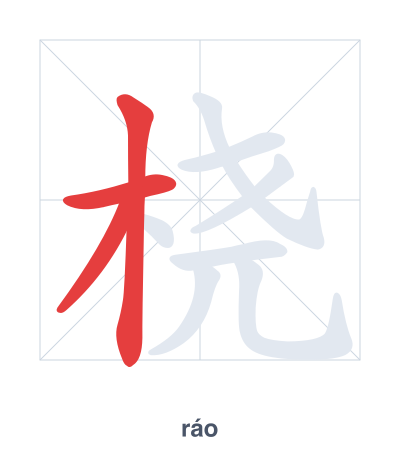
Open Hanzi Writer to see the animated stroke order and practice writing 桡 with real-time feedback.
The character 桡 (ráo) is written with 10 strokes. Follow the standard Chinese stroke order: top to bottom, left to right, outside before inside. The radical 木 is one of its key components.
Practice the correct stroke order with the Hanzi Writer app to see animated stroke-by-stroke guidance with real-time feedback.
桡 means Radius (bone) / Oar.
The character 桡 is a phono-semantic compound where 木 (wood/tree) indicates the material of an oar, and 尧 provides the sound ráo. Its meaning as 'radius bone' likely comes from the bone's oar-like shape, which also inspired the term 桡骨 (radius).
💡 Memory Tip: Picture a wooden oar (木) with a tall rower (尧) pulling it—that oar looks just like the radius bone in your arm.
他的桡骨受伤了。
tā de ráo gǔ shòu shāng le
His radius bone is injured.
医生在摸桡动脉。
yī shēng zài mō ráo dòng mài
The doctor is feeling the radial artery.
舟桡在水中划动。
zhōu ráo zài shuǐ zhōng huà dòng
The oars are paddling in the water.
Open Hanzi Writer to see the animated stroke order and practice writing 桡 with real-time feedback.
✨ Animated stroke order · Handwriting recognition · HSK-graded practice · Free to use
The character 桡 combines the radical 木 (wood) on the left with 尧 on the right. The wood radical hints at the oar meaning, since oars are often made of wood. The right part provides pronunciation (ráo) and does not directly relate to the radius bone, but the character is used in medical terms for bones near the forearm.