藨 (biāo) means "wild berry; sedge" in Chinese. It has 19 strokes with the radical 艹.
Rated 4.2/5 in difficulty (advanced).
Appears in 3+ common words including 藨草 (biāo cǎo), 藨莓 (biāo méi), 藨子 (biāo zi).
Due to its 19 strokes, Hanzi Writer's error detection shows 藨 requires focused practice — most learners need 10+ attempts for consistent accuracy.
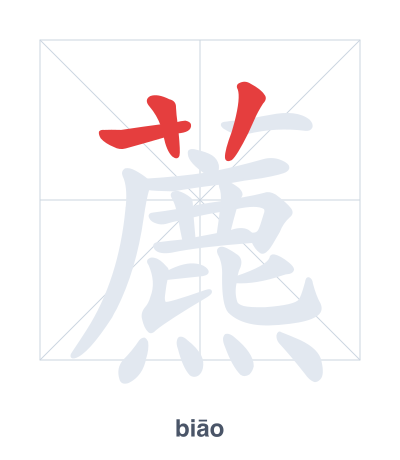
Open Hanzi Writer to see the animated stroke order and practice writing 藨 with real-time feedback.
The character 藨 (biāo) is written with 19 strokes. Follow the standard Chinese stroke order: top to bottom, left to right, outside before inside. The radical 艹 is one of its key components.
Practice the correct stroke order with the Hanzi Writer app to see animated stroke-by-stroke guidance with real-time feedback.
藨 means wild berry; sedge.
藨 is a phono-semantic compound: the grass radical 艹 indicates it is a plant, while the component 麃 (biāo, a type of deer) provides the sound. It originally referred to a kind of wild berry or sedge.
💡 Memory Tip: Picture a deer (麃) happily munching on wild berries hidden under a canopy of grass (艹).
湖边有很多藨草。
hú biān yǒu hěn duō biāo cǎo
There are many bulrushes by the lake.
这种藨莓可以吃。
zhè zhǒng biāo méi kě yǐ chī
This raspberry is edible.
藨子长在山上。
biāo zi zhǎng zài shān shàng
Wild berries grow on the mountain.
Open Hanzi Writer to see the animated stroke order and practice writing 藨 with real-time feedback.
✨ Animated stroke order · Handwriting recognition · HSK-graded practice · Free to use
藨 is a phono-semantic compound. The radical 艹 (grass) on top suggests the character relates to plants or herbs, matching the botanical meanings of wild berry and sedge. The lower part 鹿 (deer) provides the pronunciation cue, as 藨 is pronounced biāo, similar to how 鹿 is pronounced lù in some contexts but here indicates sound.