蚺 (rán) means "Python / Boa" in Chinese. It has 11 strokes with the radical 虫.
Rated 4.2/5 in difficulty (advanced).
Appears in 3+ common words including 蚺蛇 (rán shé), 水蚺 (shuǐ rán), 大蚺 (dà rán).
Due to its 11 strokes, Hanzi Writer's error detection shows 蚺 requires focused practice — most learners need 10+ attempts for consistent accuracy.
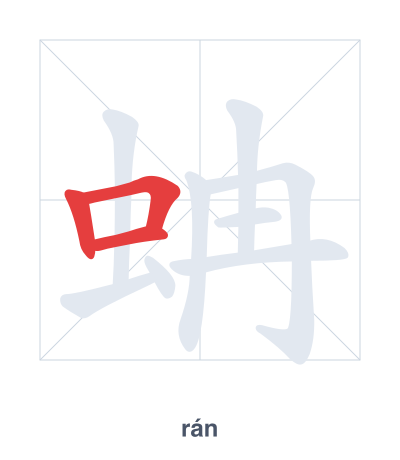
Open Hanzi Writer to see the animated stroke order and practice writing 蚺 with real-time feedback.
The character 蚺 (rán) is written with 11 strokes. Follow the standard Chinese stroke order: top to bottom, left to right, outside before inside. The radical 虫 is one of its key components.
Practice the correct stroke order with the Hanzi Writer app to see animated stroke-by-stroke guidance with real-time feedback.
蚺 means Python / Boa.
蚺 is a phono-semantic compound: the radical 虫 (insect/reptile) indicates it is a snake or reptile, while 冉 (rán) provides the pronunciation. The character's form visually suggests a large snake like a python or boa through the reptile radical.
💡 Memory Tip: Imagine a giant python coiled around the character 冉 (which looks like a long curvy rope), with its body forming the 虫 radical on the left.
蚺蛇在树上。
rán shé zài shù shàng
The python is in the tree.
水蚺游得很快。
shuǐ rán yóu dé hěn kuài
The anaconda swims very fast.
这是一条大蚺。
zhè shì yī tiáo dà rán
This is a large boa.
Open Hanzi Writer to see the animated stroke order and practice writing 蚺 with real-time feedback.
✨ Animated stroke order · Handwriting recognition · HSK-graded practice · Free to use
The character 蚺 is formed by the radical 虫 (insect/reptile) on the left and 冉 (rǎn) on the right. Since 虫 indicates that the word relates to reptiles or worms, and 冉 provides the pronunciation, 蚺 refers to a large snake like a python or boa.