鸲 (qú) means "robin / myna" in Chinese. It has 10 strokes with the radical 鸟.
Rated 4.2/5 in difficulty (advanced).
Appears in 3+ common words including 鸲鹆 (qú yù), 蓝鸲 (lán qú), 鸲鹟 (qú wēng).
Due to its 10 strokes, Hanzi Writer's error detection shows 鸲 requires focused practice — most learners need 10+ attempts for consistent accuracy.
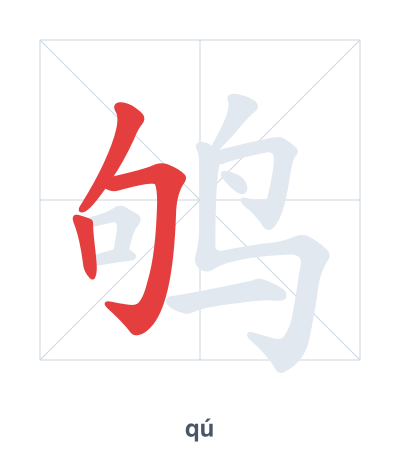
Open Hanzi Writer to see the animated stroke order and practice writing 鸲 with real-time feedback.
The character 鸲 (qú) is written with 10 strokes. Follow the standard Chinese stroke order: top to bottom, left to right, outside before inside. The radical 鸟 is one of its key components.
Practice the correct stroke order with the Hanzi Writer app to see animated stroke-by-stroke guidance with real-time feedback.
鸲 means robin / myna.
鸲 is a phono-semantic compound: the left radical 鸟 (bird) indicates the meaning, while the right component 句 (here pronounced qú, originally meaning 'sentence' or 'phrase') gives the sound and suggests the bird's call—a short, repeating phrase, just as mynas and robins are known for their vocalizations.
💡 Memory Tip: Picture a myna bird (鸟) perched on a speech bubble shaped like 句, repeating a catchy phrase.
鸲鹆会模仿人说话。
qú yù huì mó fǎng rén shuō huà
Mynas can mimic human speech.
那是一只漂亮的蓝鸲。
nà shì yī zhī piào liàng de lán qú
That is a beautiful bluebird.
鸲鹟在树上唱歌。
qú wēng zài shù shàng chàng gē
The robin is singing in the tree.
Open Hanzi Writer to see the animated stroke order and practice writing 鸲 with real-time feedback.
✨ Animated stroke order · Handwriting recognition · HSK-graded practice · Free to use
鸲 is a left-right character. The left side 句 (jù) provides phonetic clues for the pronunciation qú, while the right side 鸟 (bird) shows that it is a type of bird. Together, they mean small birds like robins and mynas.