蘧 (qú) means "a type of grain; startled" in Chinese. It has 19 strokes with the radical 艹.
Rated 4.2/5 in difficulty (advanced).
Appears in 3+ common words including 蘧然 (qú rán), 蘧庐 (qú lú), 蘧蘧 (qú qú).
Due to its 19 strokes, Hanzi Writer's error detection shows 蘧 requires focused practice — most learners need 10+ attempts for consistent accuracy.
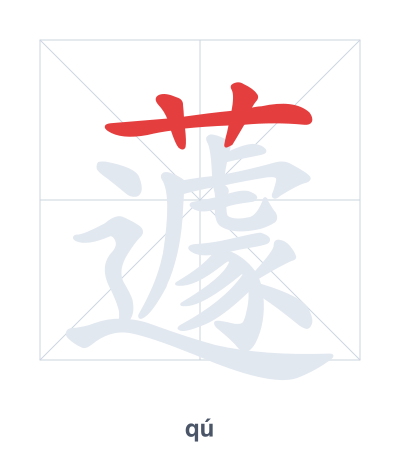
Open Hanzi Writer to see the animated stroke order and practice writing 蘧 with real-time feedback.
The character 蘧 (qú) is written with 19 strokes. Follow the standard Chinese stroke order: top to bottom, left to right, outside before inside. The radical 艹 is one of its key components.
Practice the correct stroke order with the Hanzi Writer app to see animated stroke-by-stroke guidance with real-time feedback.
蘧 means a type of grain; startled.
The character 蘧 combines the radical 艹 (grass) indicating it is a plant, with the phonetic component 遽 (jù, meaning hurried or startled). The lower part 遽 itself contains 虍 (tiger) and 豕 (pig) under 辶 (walk), suggesting a sudden movement that links to the secondary meaning 'startled'. Originally it referred to a type of grain, possibly buckwheat, but later also gained the sense of being alarmed.
💡 Memory Tip: A startled tiger (虍) leaps over a pig (豕) and dashes away (辶) through the grass (艹), upsetting a bundle of grain.
他蘧然从梦中醒来。
tā qú rán cóng mèng zhōng xǐng lái
He suddenly woke up from a dream.
人生就像住蘧庐。
rén shēng jiù xiàng zhù qú lú
Life is like staying in a temporary lodging.
蝴蝶在花间蘧蘧飞舞。
hú dié zài huā jiān qú qú fēi wǔ
The butterfly is flying freely among the flowers.
Open Hanzi Writer to see the animated stroke order and practice writing 蘧 with real-time feedback.
✨ Animated stroke order · Handwriting recognition · HSK-graded practice · Free to use
蘧 has the radical 艹 (grass) on top, suggesting a plant-related meaning like a type of grain. The bottom part 豦 (jù) provides the sound clue for the pinyin qú, while the radical hints at the grain meaning. For the "startled" meaning, the connection is less direct, but the character is mainly used in literary terms.