蛆 (qū) means "Maggot" in Chinese. It has 11 strokes with the radical 虫.
Rated 4.2/5 in difficulty (advanced).
Appears in 3+ common words including 蛆虫 (qū chóng), 生蛆 (shēng qū), 苍蝇蛆 (cāng yíng qū).
Due to its 11 strokes, Hanzi Writer's error detection shows 蛆 requires focused practice — most learners need 10+ attempts for consistent accuracy.
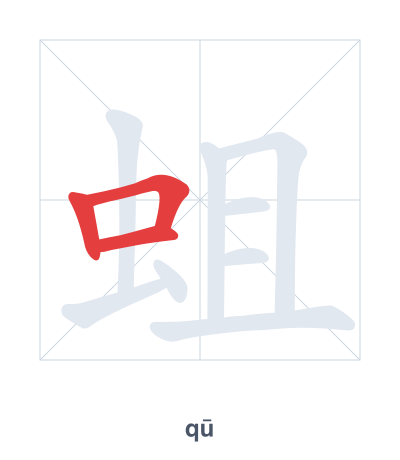
Open Hanzi Writer to see the animated stroke order and practice writing 蛆 with real-time feedback.
The character 蛆 (qū) is written with 11 strokes. Follow the standard Chinese stroke order: top to bottom, left to right, outside before inside. The radical 虫 is one of its key components.
Practice the correct stroke order with the Hanzi Writer app to see animated stroke-by-stroke guidance with real-time feedback.
蛆 means Maggot.
蛆 is a phono-semantic compound: the radical 虫 (insect) indicates it is a type of insect, while the component 且 (qiě) provides the pronunciation. Maggots are the larvae of flies, fitting the insect category.
💡 Memory Tip: Picture a maggot (虫) wriggling on a dining table (且), forming a gross scene of decay.
垃圾里有蛆虫。
lā jī lǐ yǒu qū chóng
There are maggots in the trash.
肉放久了会生蛆。
ròu fàng jiǔ le huì shēng qū
Meat left out for too long will breed maggots.
苍蝇蛆很恶心。
cāng yíng qū hěn ě xīn
Maggots are disgusting.
Open Hanzi Writer to see the animated stroke order and practice writing 蛆 with real-time feedback.
✨ Animated stroke order · Handwriting recognition · HSK-graded practice · Free to use
The character 蛆 is made of the radical 虫 (insect) on the left, showing that a maggot is a type of insect larva. The right side is 且 (qiě), which gives a rough phonetic hint, though the pronunciation is not exact. Together, the structure tells you it is an insect-like creature related to decay.