黥 (qíng) means "To tattoo (as a punishment)" in Chinese. It has 20 strokes with the radical 黑.
Rated 4.2/5 in difficulty (advanced).
Appears in 3+ common words including 黥面 (qíng miàn), 黥刑 (qíng xíng), 黥首 (qíng shǒu).
Due to its 20 strokes, Hanzi Writer's error detection shows 黥 requires focused practice — most learners need 10+ attempts for consistent accuracy.
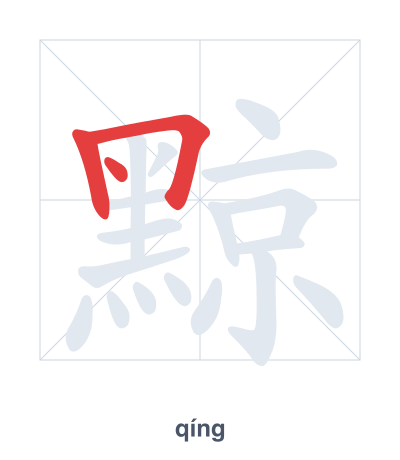
Open Hanzi Writer to see the animated stroke order and practice writing 黥 with real-time feedback.
The character 黥 (qíng) is written with 20 strokes. Follow the standard Chinese stroke order: top to bottom, left to right, outside before inside. The radical 黑 is one of its key components.
Practice the correct stroke order with the Hanzi Writer app to see animated stroke-by-stroke guidance with real-time feedback.
黥 means To tattoo (as a punishment).
| Character | 黥 |
| Pinyin | qíng (qing) |
| Meaning | To tattoo (as a punishment) |
| Strokes | 20 |
| Radical | 黑 |
| Difficulty | 4.2/5 |
This compound character is formed by the radical 黑 (black, ink) and the phonetic component 京 (jīng, meaning 'capital' but here indicating pronunciation qíng). The meaning 'to tattoo as a punishment' comes from the idea of permanently marking a criminal's face with black ink, often as a penal branding in ancient China.
💡 Memory Tip: Picture a prisoner with a large black '京' (like a capital letter) tattooed across their forehead as a permanent punishment.
黥面是古代的刑罚。
qíng miàn shì gǔ dài de xíng fá
Tattooing the face was a punishment in ancient times.
他被处以黥刑。
tā bèi chǔ yǐ qíng xíng
He was sentenced to the punishment of tattooing.
黥首是古代的刑罚。
qíng shǒu shì gǔ dài de xíng fá
Tattooing the forehead was a punishment in ancient times.
Open Hanzi Writer to see the animated stroke order and practice writing 黥 with real-time feedback.
✨ Animated stroke order · Handwriting recognition · HSK-graded practice · Free to use
The character 黥 combines the radical 黑 (black) on top and 京 (jīng, capital) on the bottom. The radical 黑 hints at the dark ink used in tattooing, while 京 provides pronunciation and also suggests the idea of a legal punishment carried out by the state.