黛 (dài) means "Black pigment for eyebrows" in Chinese. It has 17 strokes with the radical 黑.
Rated 4.2/5 in difficulty (advanced).
Appears in 3+ common words including 黛色 (dài sè), 粉黛 (fěn dài), 黛眉 (dài méi).
Due to its 17 strokes, Hanzi Writer's error detection shows 黛 requires focused practice — most learners need 10+ attempts for consistent accuracy.
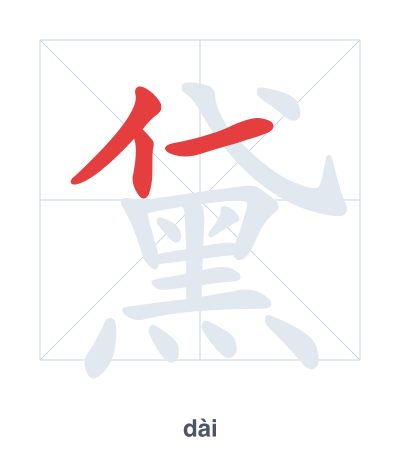
Open Hanzi Writer to see the animated stroke order and practice writing 黛 with real-time feedback.
The character 黛 (dài) is written with 17 strokes. Follow the standard Chinese stroke order: top to bottom, left to right, outside before inside. The radical 黑 is one of its key components.
Practice the correct stroke order with the Hanzi Writer app to see animated stroke-by-stroke guidance with real-time feedback.
黛 means Black pigment for eyebrows.
| Character | 黛 |
| Pinyin | dài (dai) |
| Meaning | Black pigment for eyebrows |
| Strokes | 17 |
| Radical | 黑 |
| Difficulty | 4.2/5 |
This compound character joins the radical 黑 (black, indicating pigment) with 代 (dài, substitute) which gives the sound and suggests using the powder to 'substitute' for natural eyebrows.
💡 Memory Tip: Imagine a lady using black powder (黑) to 'substitute' (代) her real eyebrows with a fashionable dark arc.
她穿着一件黛色的长裙。
tā chuān zhe yī jiàn dài sè de zhǎng qún
She is wearing a dark blue long skirt.
她不施粉黛也很漂亮。
tā bù shī fěn dài yě hěn piào liàng
She is beautiful even without makeup.
她的黛眉弯弯的。
tā de dài méi wān wān de
Her dark eyebrows are curved.
Open Hanzi Writer to see the animated stroke order and practice writing 黛 with real-time feedback.
✨ Animated stroke order · Handwriting recognition · HSK-graded practice · Free to use
Together, the structure visually and phonetically encodes 'black substitute' for the eyebrows.