拑 (qián) means "To clamp / To pinch" in Chinese. It has 8 strokes with the radical 扌.
Rated 3.7/5 in difficulty (challenging).
Appears in 3+ common words including 拑住 (qián zhù), 拑口 (qián kǒu), 拑制 (qián zhì).
Due to its 8 strokes, Hanzi Writer's error detection shows 拑 requires focused practice — most learners need 10+ attempts for consistent accuracy.
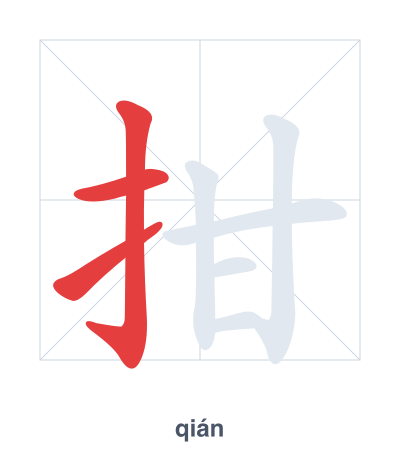
Open Hanzi Writer to see the animated stroke order and practice writing 拑 with real-time feedback.
The character 拑 (qián) is written with 8 strokes. Follow the standard Chinese stroke order: top to bottom, left to right, outside before inside. The radical 扌 is one of its key components.
Practice the correct stroke order with the Hanzi Writer app to see animated stroke-by-stroke guidance with real-time feedback.
拑 means To clamp / To pinch.
拑 is a phono-semantic compound: the hand radical 扌 (hand) indicates the action of pinching or clamping, while 甘 (sweet) provides the pronunciation and also evokes the idea of holding something as if grasping a sweet morsel.
💡 Memory Tip: Imagine your hand (扌) clamping down on a sweet candy (甘) so hard it pinches right through.
他拑住了对方的手。
tā qián zhù le duì fāng de shǒu
He gripped the other person's hand tightly.
他拑口不言。
tā qián kǒu bù yán
He kept his mouth shut.
这种力量被拑制了。
zhè zhǒng lì liàng bèi qián zhì le
This power has been restrained.
Open Hanzi Writer to see the animated stroke order and practice writing 拑 with real-time feedback.
✨ Animated stroke order · Handwriting recognition · HSK-graded practice · Free to use
The character 拑 has the radical 扌 on the left, which means hand or action, and the component 甘 on the right, which gives the sound qián. Together, the hand radical shows that the word is about a physical action, and the meaning is to clamp or pinch.