綮 (qǐ/qìng) means "vital point; joint where bones and muscles meet" in Chinese. It has 14 strokes with the radical 糸.
Rated 4.2/5 in difficulty (advanced).
Appears in 3+ common words including 肯綮 (kěn qìng), 綮处 (qǐ chù), 綮肯 (qǐ kěn).
Due to its 14 strokes, Hanzi Writer's error detection shows 綮 requires focused practice — most learners need 10+ attempts for consistent accuracy.
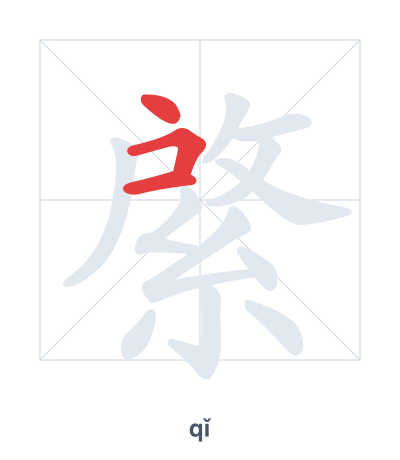
Open Hanzi Writer to see the animated stroke order and practice writing 綮 with real-time feedback.
The character 綮 (qǐ/qìng) is written with 14 strokes. Follow the standard Chinese stroke order: top to bottom, left to right, outside before inside. The radical 糸 is one of its key components.
Practice the correct stroke order with the Hanzi Writer app to see animated stroke-by-stroke guidance with real-time feedback.
綮 means vital point; joint where bones and muscles meet.
This is a polyphonic character with readings: qǐ, qìng.
| Character | 綮 |
| Pinyin | qǐ / qìng (qi/qing) |
| Meaning | vital point; joint where bones and muscles meet |
| Strokes | 14 |
| Radical | 糸 |
| Difficulty | 4.2/5 |
綮 combines the radical 糸 (silk thread), which can represent a binding or connecting point, with the component 啟 (to open), hinting at the joint's ability to open and close like a hinge. Together, they depict the crucial spot where bones and muscles meet, held together by sinews that allow movement.
💡 Memory Tip: Imagine a silk thread (糸) precisely tied at the opening (啟) of a door hinge—that vital pivot point is the 綮, the joint where everything moves.
这个问题抓住了肯綮。
zhè ge wèn tí zhuā zhù le kěn qìng
This question gets to the heart of the matter.
这里的綮处很重要。
zhè lǐ de qǐ chù hěn zhòng yào
The key points here are very important.
他的分析非常綮肯。
tā de fēn xī fēi cháng qǐ kěn
His analysis is very much to the point.
Open Hanzi Writer to see the animated stroke order and practice writing 綮 with real-time feedback.
✨ Animated stroke order · Handwriting recognition · HSK-graded practice · Free to use
綮 is composed of 糸 (silk thread) on top and 啟 (meaning 'to open' or 'begin') below. The silk thread suggests connection or binding, while 啟 hints at a critical opening; together they evoke the idea of a vital joint where bones and muscles meet, like a key point in a system.