镤 (pú) means "protactinium (element)" in Chinese. It has 17 strokes with the radical 钅.
Rated 4.2/5 in difficulty (advanced).
Appears in 3+ common words including 镤元素 (pú yuán sù), 镤原子 (pú yuán zi), 金属镤 (jīn shǔ pú).
Due to its 17 strokes, Hanzi Writer's error detection shows 镤 requires focused practice — most learners need 10+ attempts for consistent accuracy.
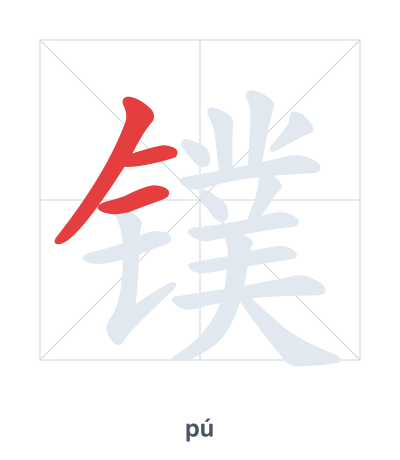
Open Hanzi Writer to see the animated stroke order and practice writing 镤 with real-time feedback.
The character 镤 (pú) is written with 17 strokes. Follow the standard Chinese stroke order: top to bottom, left to right, outside before inside. The radical 钅 is one of its key components.
Practice the correct stroke order with the Hanzi Writer app to see animated stroke-by-stroke guidance with real-time feedback.
镤 means protactinium (element).
This character is a phono-semantic compound. The radical 钅 (gold/metal) indicates it is a metallic element, while the component 菐 (pú) provides the pronunciation. Protactinium is a radioactive metal, hence the metal radical.
💡 Memory Tip: Picture a metal (钅) protactinium atom with a grass-like (艹) tuft on top and a business (業) briefcase, acting like a radioactive executive.
镤元素在自然界中很少。
pú yuán sù zài zì rán jiè zhōng hěn shǎo
Protactinium is very rare in nature.
这是一个镤原子模型。
zhè shì yí gè pú yuán zi mó xíng
This is a protactinium atom model.
金属镤具有放射性。
jīn shǔ pú jù yǒu fàng shè xìng
Protactinium metal is radioactive.
Open Hanzi Writer to see the animated stroke order and practice writing 镤 with real-time feedback.
✨ Animated stroke order · Handwriting recognition · HSK-graded practice · Free to use
镤 is composed of the radical 钅 (jīn, meaning 'metal' or 'gold') on the left and the phonetic component 菐 (pú) on the right. The metal radical indicates it is related to a chemical element, while the right side provides the pronunciation pú. This structure is common for Chinese names of metallic elements.