蒲 (pú) means "Bulrush or cattail" in Chinese. It has 13 strokes with the radical 艹.
Rated 4.2/5 in difficulty (advanced).
Appears in 3+ common words including 蒲公英 (pú gōng yīng), 蒲扇 (pú shàn), 菖蒲 (chāng pú).
Due to its 13 strokes, Hanzi Writer's error detection shows 蒲 requires focused practice — most learners need 10+ attempts for consistent accuracy.
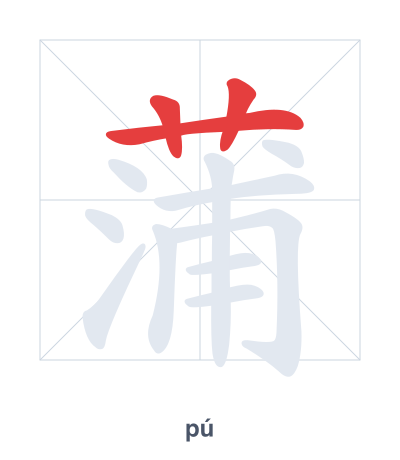
Open Hanzi Writer to see the animated stroke order and practice writing 蒲 with real-time feedback.
The character 蒲 (pú) is written with 13 strokes. Follow the standard Chinese stroke order: top to bottom, left to right, outside before inside. The radical 艹 is one of its key components.
Practice the correct stroke order with the Hanzi Writer app to see animated stroke-by-stroke guidance with real-time feedback.
蒲 means Bulrush or cattail.
蒲 is a phono-semantic compound. The radical 艹 (grass) indicates it is a type of plant, while the phonetic component 浦 (pǔ, meaning 'waterside') hints at its habitat—bulrushes and cattails grow in wet, marshy areas. Together, the character pictures a water-edge plant.
💡 Memory Tip: Imagine a lush patch of grass (艹) by the water (浦), where sturdy cattail stalks stand tall like fuzzy hot dogs on a stick.
蒲公英很漂亮。
pú gōng yīng hěn piào liàng
Dandelions are very beautiful.
奶奶拿着蒲扇。
nǎi nǎi ná zhe pú shàn
Grandma is holding a cattail leaf fan.
门口挂着菖蒲。
mén kǒu guà zhe chāng pú
Calamus is hanging at the entrance.
Open Hanzi Writer to see the animated stroke order and practice writing 蒲 with real-time feedback.
✨ Animated stroke order · Handwriting recognition · HSK-graded practice · Free to use
蒲 has the grass radical 艹 on top, which shows it is a plant. The bottom part 浦 (pǔ) gives the sound and hints at water, since bulrushes and cattails grow near water.