鲍 (bào) means "Abalone" in Chinese. It has 13 strokes with the radical 鱼.
Rated 4.2/5 in difficulty (advanced).
Appears in 3+ common words including 鲍鱼 (bào yú), 鲍鱼汁 (bào yú zhī), 鲍先生 (bào xiān shēng).
Due to its 13 strokes, Hanzi Writer's error detection shows 鲍 requires focused practice — most learners need 10+ attempts for consistent accuracy.
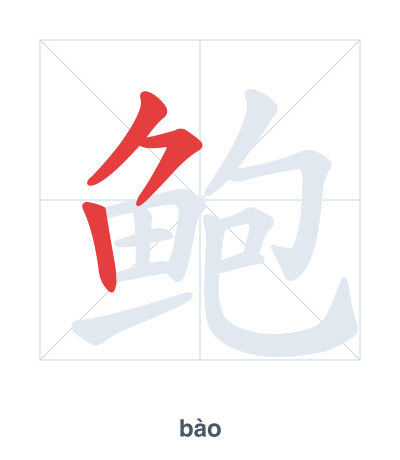
Open Hanzi Writer to see the animated stroke order and practice writing 鲍 with real-time feedback.
The character 鲍 (bào) is written with 13 strokes. Follow the standard Chinese stroke order: top to bottom, left to right, outside before inside. The radical 鱼 is one of its key components.
Practice the correct stroke order with the Hanzi Writer app to see animated stroke-by-stroke guidance with real-time feedback.
鲍 means Abalone.
鲍 combines the radical 鱼 (fish) and the phonetic component 包 (bāo, 'to wrap'). An abalone is a marine mollusk with a shell that resembles a wrapped fish or a fish enclosed in a shell.
💡 Memory Tip: Picture a fish (鱼) wrapped up inside a bag (包) — that's your abalone, sealed tight in its shell.
鲍鱼的味道很好。
bào yú de wèi dào hěn hǎo
Abalone tastes delicious.
我喜欢鲍鱼汁。
wǒ xǐ huān bào yú zhī
I like abalone sauce.
鲍先生是我的老师。
bào xiān shēng shì wǒ de lǎo shī
Mr. Bao is my teacher.
Open Hanzi Writer to see the animated stroke order and practice writing 鲍 with real-time feedback.
✨ Animated stroke order · Handwriting recognition · HSK-graded practice · Free to use
鲍 is made of two parts: the left side is 鱼 (fish radical), and the right side is 包 (bāo, meaning 'to wrap'). The fish radical shows that 鲍 relates to seafood, while 包 gives the pronunciation and hints at how an abalone's meat is wrapped inside its shell.