砲 (pào) means "cannon / artillery" in Chinese. It has 10 strokes with the radical 石.
Rated 4.2/5 in difficulty (advanced).
Appears in 3+ common words including 砲兵 (pào bīng), 砲台 (pào tái), 砲火 (pào huǒ).
Due to its 10 strokes, Hanzi Writer's error detection shows 砲 requires focused practice — most learners need 10+ attempts for consistent accuracy.
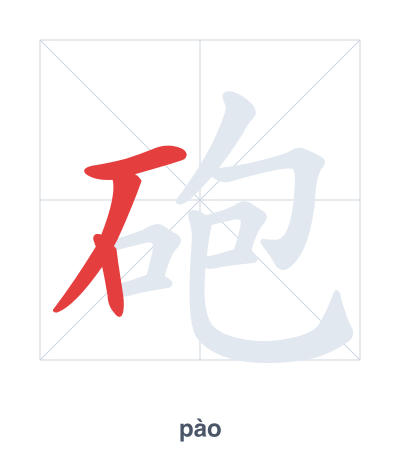
Open Hanzi Writer to see the animated stroke order and practice writing 砲 with real-time feedback.
The character 砲 (pào) is written with 10 strokes. Follow the standard Chinese stroke order: top to bottom, left to right, outside before inside. The radical 石 is one of its key components.
Practice the correct stroke order with the Hanzi Writer app to see animated stroke-by-stroke guidance with real-time feedback.
砲 means cannon / artillery.
砲 combines the radical 石 (stone, referring to the stone projectiles) with 包 (bāo, 'wrap' or 'package'), which provides the sound and hints at the contained explosive charge. Originally it depicted a stone-throwing catapult, and later came to mean gunpowder cannon.
💡 Memory Tip: Imagine a stone (石) wrapped (包) in a bundle being launched from a cannon—a 'stone package' that explodes on impact.
他是一名砲兵。
tā shì yī míng pào bīng
He is an artilleryman.
山上有一个旧砲台。
shān shàng yǒu yí gè jiù pào tái
There is an old battery on the mountain.
这里的砲火很猛。
zhè lǐ de pào huǒ hěn měng
The artillery fire here is very intense.
Open Hanzi Writer to see the animated stroke order and practice writing 砲 with real-time feedback.
✨ Animated stroke order · Handwriting recognition · HSK-graded practice · Free to use
砲 is made of the radical 石 (stone) on the left and 包 (bāo, meaning "to wrap") on the right. The stone radical indicates that early cannons were made of stone, and 包 gives a hint to the pronunciation pào while suggesting the "wrapped" shape of the barrel.