泮 (pàn) means "To melt / To dissolve" in Chinese. It has 8 strokes with the radical 氵.
Rated 3.7/5 in difficulty (challenging).
Appears in 3+ common words including 冰泮 (bīng pàn), 泮宫 (pàn gōng), 消泮 (xiāo pàn).
Due to its 8 strokes, Hanzi Writer's error detection shows 泮 requires focused practice — most learners need 10+ attempts for consistent accuracy.
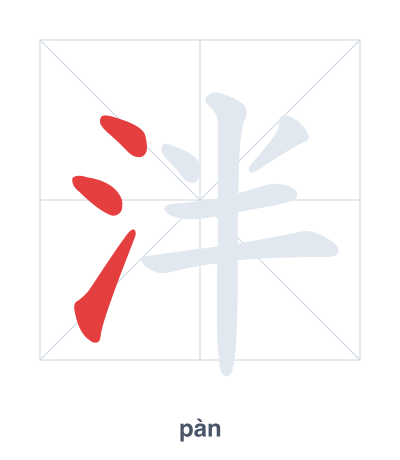
Open Hanzi Writer to see the animated stroke order and practice writing 泮 with real-time feedback.
The character 泮 (pàn) is written with 8 strokes. Follow the standard Chinese stroke order: top to bottom, left to right, outside before inside. The radical 氵 is one of its key components.
Practice the correct stroke order with the Hanzi Writer app to see animated stroke-by-stroke guidance with real-time feedback.
泮 means To melt / To dissolve.
The character 泮 combines the water radical 氵 with 半 (half), suggesting water that is only partially solid—like ice melting into liquid. In ancient usage, 泮 specifically described the thawing of ice, where the surface breaks into half-frozen, half-liquid patches.
💡 Memory Tip: Picture an ice cube (半) submerged in water (氵) with its top half still solid and bottom half already melted away.
湖里的冰泮了。
hú lǐ de bīng pàn le
The ice on the lake has melted.
泮宫是古代学校。
pàn gōng shì gǔ dài xué xiào
Pangong was an ancient school.
冰雪已经消泮。
bīng xuě yǐ jīng xiāo pàn
The ice and snow have already melted.
Open Hanzi Writer to see the animated stroke order and practice writing 泮 with real-time feedback.
✨ Animated stroke order · Handwriting recognition · HSK-graded practice · Free to use
泮 is made of the water radical 氵 on the left and 半 (bàn, meaning half) on the right. Water causes ice to break into halves as it melts, so the character combines water with the idea of splitting to mean melting or dissolving.