槃 (pán) means "Tray or plate" in Chinese. It has 14 strokes with the radical 木.
Rated 4.2/5 in difficulty (advanced).
Appears in 3+ common words including 涅槃 (niè pán), 槃石 (pán shí), 槃旋 (pán xuán).
Due to its 14 strokes, Hanzi Writer's error detection shows 槃 requires focused practice — most learners need 10+ attempts for consistent accuracy.
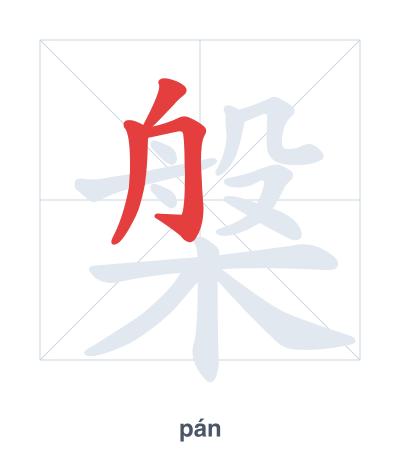
Open Hanzi Writer to see the animated stroke order and practice writing 槃 with real-time feedback.
The character 槃 (pán) is written with 14 strokes. Follow the standard Chinese stroke order: top to bottom, left to right, outside before inside. The radical 木 is one of its key components.
Practice the correct stroke order with the Hanzi Writer app to see animated stroke-by-stroke guidance with real-time feedback.
槃 means Tray or plate.
This is a phono-semantic compound. The radical 木 (wood) shows the material, as ancient trays were often wooden. The component 般 (pán) provides the pronunciation and also carries the hint of 'spinning' or 'turning', possibly referencing a round serving tray.
💡 Memory Tip: Picture a wooden (木) tray so big it holds a tiny boat (舟) with a paddle (殳) — that's your giant plate for a feast.
凤凰在火中涅槃。
fèng huáng zài huǒ zhōng niè pán
The phoenix attains nirvana in the fire.
槃石非常坚硬。
pán shí fēi cháng jiān yìng
The huge rock is very hard.
雄鹰在空中槃旋。
xióng yīng zài kōng zhōng pán xuán
The eagle circles in the air.
Open Hanzi Writer to see the animated stroke order and practice writing 槃 with real-time feedback.
✨ Animated stroke order · Handwriting recognition · HSK-graded practice · Free to use
槃 is a left-right character. The left part is 般 (bān), which provides pronunciation, and the right part is 木 (mù), meaning wood, indicating that a tray was originally made of wood. Together, they form a character meaning "wooden tray" or "plate."