糯 (nuò) means "Glutinous / Sticky (rice)" in Chinese. It has 20 strokes with the radical 米.
Rated 4.2/5 in difficulty (advanced).
Appears in 3+ common words including 糯米 (nuò mǐ), 糯米粉 (nuò mǐ fěn), 软糯 (ruǎn nuò).
Due to its 20 strokes, Hanzi Writer's error detection shows 糯 requires focused practice — most learners need 10+ attempts for consistent accuracy.
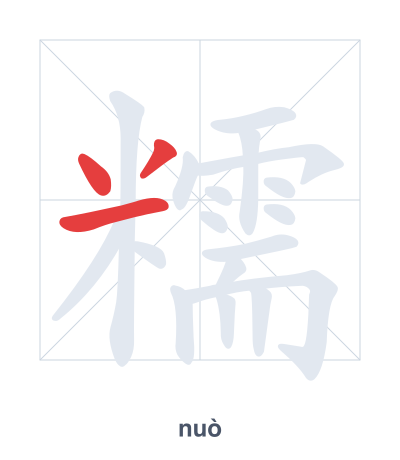
Open Hanzi Writer to see the animated stroke order and practice writing 糯 with real-time feedback.
The character 糯 (nuò) is written with 20 strokes. Follow the standard Chinese stroke order: top to bottom, left to right, outside before inside. The radical 米 is one of its key components.
Practice the correct stroke order with the Hanzi Writer app to see animated stroke-by-stroke guidance with real-time feedback.
糯 means Glutinous / Sticky (rice).
糯 is a phono-semantic compound where 米 (rice) indicates the grain category, and 需 (xū, meaning 'need' but also phonetically approximating nuò) hints at the soft, sticky texture of glutinous rice—similar to the character 懦 (nuò, 'timid, soft'). The combination visually says 'the rice that is soft and sticky, like what you need for dumplings.'
💡 Memory Tip: Imagine you NEED (需) sticky rice (米) to make mochi, and as you knead it, it sticks to everything—that's 糯!
糯米可以做饭。
nuò mǐ kě yǐ zuò fàn
Glutinous rice can be used to cook meals.
这是糯米粉。
zhè shì nuò mǐ fěn
This is glutinous rice flour.
这个蛋糕很软糯。
zhè ge dàn gāo hěn ruǎn nuò
This cake is soft and chewy.
Open Hanzi Writer to see the animated stroke order and practice writing 糯 with real-time feedback.
✨ Animated stroke order · Handwriting recognition · HSK-graded practice · Free to use
The left side is the radical 米, which means "rice," indicating the character relates to rice or grains. The right side is 需 (xū, need), which partly hints at the pronunciation and also conveys the idea of something soft or sticky. Together, 糯 describes rice that is glutinous and sticky.