驽 (nú) means "inferior horse; slow horse" in Chinese. It has 8 strokes with the radical 马.
Rated 3.7/5 in difficulty (challenging).
Appears in 3+ common words including 驽马 (nú mǎ), 驽钝 (nú dùn), 驽马十驾 (nú mǎ shí jià).
Due to its 8 strokes, Hanzi Writer's error detection shows 驽 requires focused practice — most learners need 10+ attempts for consistent accuracy.
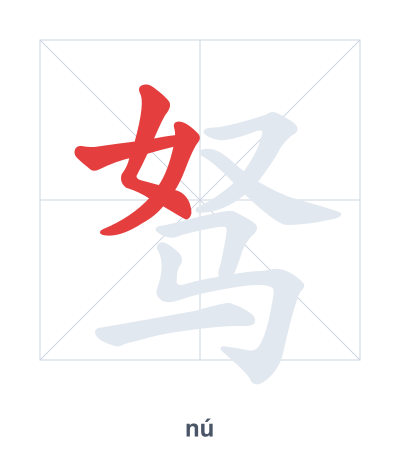
Open Hanzi Writer to see the animated stroke order and practice writing 驽 with real-time feedback.
The character 驽 (nú) is written with 8 strokes. Follow the standard Chinese stroke order: top to bottom, left to right, outside before inside. The radical 马 is one of its key components.
Practice the correct stroke order with the Hanzi Writer app to see animated stroke-by-stroke guidance with real-time feedback.
驽 means inferior horse; slow horse.
驽 is a compound character combining the radical 马 (horse) with 奴 (slave), which also provides the pronunciation. The meaning 'inferior horse' comes from the idea of a horse that is as lowly and slow as a slave, unfit for noble use.
💡 Memory Tip: Imagine a horse (马) that moves sluggishly because it's pulling a heavy load for a slave (奴), making it an inferior, slow horse.
驽马也要努力跑。
nú mǎ yě yào nǔ lì pǎo
Even a slow horse must strive to run.
我天资驽钝,请多指教。
wǒ tiān zī nú dùn qǐng duō zhǐ jiào
I'm not very gifted, please guide me.
只要坚持,驽马十驾。
zhǐ yào jiān chí nú mǎ shí jià
Persistence pays off; even a slow horse can go far with effort.
Open Hanzi Writer to see the animated stroke order and practice writing 驽 with real-time feedback.
✨ Animated stroke order · Handwriting recognition · HSK-graded practice · Free to use
驽 is made of two parts: the radical 马 (horse) on the right and the phonetic component 奴 (nú, meaning slave) on the left. The 马 indicates the character relates to horses, while 奴 suggests a low or inferior quality, together forming the meaning "inferior horse."