怩 (ní) means "shy; bashful" in Chinese. It has 8 strokes with the radical 忄.
Rated 3.7/5 in difficulty (challenging).
Appears in 3+ common words including 忸怩 (niǔ ní), 羞怩 (xiū ní), 怩怩不安 (ní ní bù ān).
Due to its 8 strokes, Hanzi Writer's error detection shows 怩 requires focused practice — most learners need 10+ attempts for consistent accuracy.
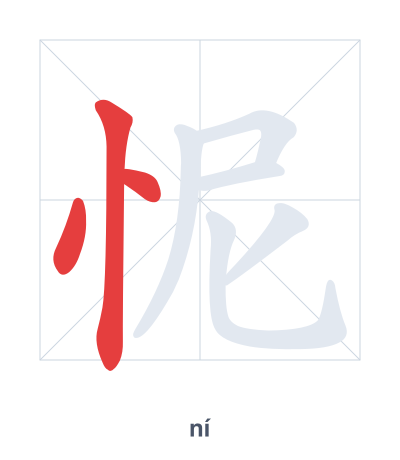
Open Hanzi Writer to see the animated stroke order and practice writing 怩 with real-time feedback.
The character 怩 (ní) is written with 8 strokes. Follow the standard Chinese stroke order: top to bottom, left to right, outside before inside. The radical 忄 is one of its key components.
Practice the correct stroke order with the Hanzi Writer app to see animated stroke-by-stroke guidance with real-time feedback.
怩 means shy; bashful.
This is a phono-semantic compound character. The radical 忄 (heart) indicates that the meaning relates to an emotion or feeling, specifically shyness or bashfulness. The component 尼 (ní) provides the pronunciation and also visually suggests a person bowing or shrinking back, reinforcing the idea of timidity.
💡 Memory Tip: Imagine a bashful nun (尼) covering her heart (忄) with her hands, too shy to speak.
她显得有些忸怩。
tā xiǎn de yǒu xiē niǔ ní
She seems a bit bashful.
别那么羞怩,大方点。
bié nà me xiū ní dà fāng diǎn
Don't be so shy; be more natural.
他说话怩怩不安。
tā shuō huà ní ní bù ān
He speaks bashfully and uneasily.
Open Hanzi Writer to see the animated stroke order and practice writing 怩 with real-time feedback.
✨ Animated stroke order · Handwriting recognition · HSK-graded practice · Free to use
怩 is made of the heart radical 忄 on the left and 尼 (ní) on the right. The heart radical connects to emotions or feelings, which fits the meaning of being shy or bashful. The right part 尼 mainly gives the pronunciation, though its original meaning of "nun" does not directly relate to shyness.