忸 (niǔ) means "shy; blushing; bashful" in Chinese. It has 7 strokes with the radical 忄.
Rated 3.5/5 in difficulty (challenging).
Appears in 3+ common words including 忸怩 (niǔ ní), 忸怩作态 (niǔ ní zuò tài), 愧忸 (kuì niǔ).
Due to its 7 strokes, Hanzi Writer's error detection shows 忸 requires focused practice — most learners need 10+ attempts for consistent accuracy.
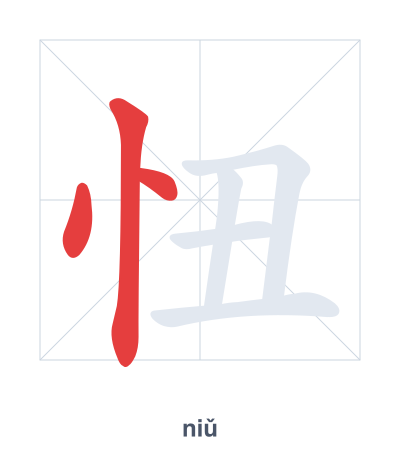
Open Hanzi Writer to see the animated stroke order and practice writing 忸 with real-time feedback.
The character 忸 (niǔ) is written with 7 strokes. Follow the standard Chinese stroke order: top to bottom, left to right, outside before inside. The radical 忄 is one of its key components.
Practice the correct stroke order with the Hanzi Writer app to see animated stroke-by-stroke guidance with real-time feedback.
忸 means shy; blushing; bashful.
忸 is a phono-semantic compound: the left side 忄 (heart radical) indicates emotion, while the right side 丑 (ugly or clownish) contributes a sense of awkwardness—together, they depict a heart feeling ugly or embarrassed, leading to shyness and blushing.
💡 Memory Tip: Picture a heart (忄) wearing a clown nose (丑) and blushing bright red because it feels awkward and shy.
她显得有些忸怩。
tā xiǎn de yǒu xiē niǔ ní
She seems a bit bashful.
别在那儿忸怩作态。
bié zài nà ér niǔ ní zuò tài
Don't be so affected over there.
心中感到十分愧忸。
xīn zhōng gǎn dào shí fēn kuì niǔ
Feeling very ashamed and embarrassed.
Open Hanzi Writer to see the animated stroke order and practice writing 忸 with real-time feedback.
✨ Animated stroke order · Handwriting recognition · HSK-graded practice · Free to use
The left side is the heart radical 忄, which shows that 忸 relates to emotions or feelings. The right side is 丑, which originally meant 'ugly' but here provides a phonetic clue, though the pronunciation differs slightly. Together, 忸 conveys a feeling of inner bashfulness or blushing, as if the heart reacts to an awkward situation.