柰 (nài) means "crabapple" in Chinese. It has 9 strokes with the radical 木.
Rated 4/5 in difficulty (challenging).
Appears in 3+ common words including 柰子 (nài zi), 无可柰何 (wú kě nài hé), 柰何 (nài hé).
Due to its 9 strokes, Hanzi Writer's error detection shows 柰 requires focused practice — most learners need 10+ attempts for consistent accuracy.
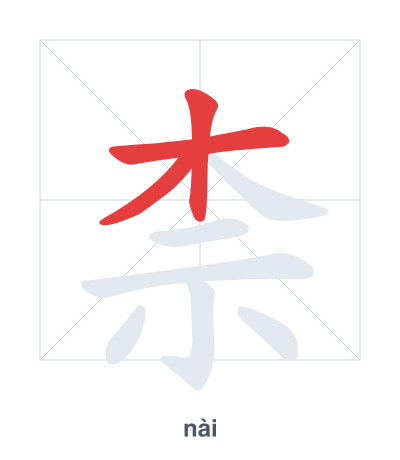
Open Hanzi Writer to see the animated stroke order and practice writing 柰 with real-time feedback.
The character 柰 (nài) is written with 9 strokes. Follow the standard Chinese stroke order: top to bottom, left to right, outside before inside. The radical 木 is one of its key components.
Practice the correct stroke order with the Hanzi Writer app to see animated stroke-by-stroke guidance with real-time feedback.
柰 means crabapple.
柰 combines 木 (tree) and 示 (altar), reflecting that the crabapple fruit was often used as an offering in ancient rituals. The character originally referred to a type of fruit tree, specifically the crabapple or a similar pear-like fruit.
💡 Memory Tip: Picture a crabapple tree (木) with a wooden sign (示) that reads 'Sacred Fruit' — the altar beneath is piled with red crabapples as offerings.
这种苹果叫柰子。
zhè zhǒng píng guǒ jiào nài zi
This kind of apple is called a crabapple.
事情已经无可柰何。
shì qíng yǐ jīng wú kě nài hé
Nothing can be done about the matter anymore.
谁也无可柰何他。
shuí yě wú kě nài hé tā
No one can do anything about him.
Open Hanzi Writer to see the animated stroke order and practice writing 柰 with real-time feedback.
✨ Animated stroke order · Handwriting recognition · HSK-graded practice · Free to use
柰 is made of the radical 木 (tree) on top and the component 奈 (nài) below. The 木 indicates that the word relates to a tree or fruit, while 奈 provides the pronunciation and originally means 'how' but here serves as a phonetic clue. Together they form the meaning 'crabapple,' a type of fruit tree.