镎 (ná) means "Neptunium" in Chinese. It has 15 strokes with the radical 钅.
Rated 4.2/5 in difficulty (advanced).
Appears in 3+ common words including 镎元素 (ná yuán sù), 镎原子 (ná yuán zi), 镎金属 (ná jīn shǔ).
Due to its 15 strokes, Hanzi Writer's error detection shows 镎 requires focused practice — most learners need 10+ attempts for consistent accuracy.
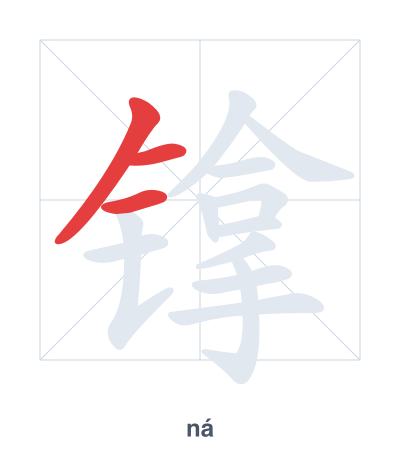
Open Hanzi Writer to see the animated stroke order and practice writing 镎 with real-time feedback.
The character 镎 (ná) is written with 15 strokes. Follow the standard Chinese stroke order: top to bottom, left to right, outside before inside. The radical 钅 is one of its key components.
Practice the correct stroke order with the Hanzi Writer app to see animated stroke-by-stroke guidance with real-time feedback.
镎 means Neptunium.
镎 is a phono-semantic compound character. The radical 钅 (gold/metal) indicates it is a metallic element, while 那 (nà) provides the pronunciation. This character was created in modern times to represent neptunium, a synthetic element named after the planet Neptune.
💡 Memory Tip: Imagine a metal (钅) asteroid shaped like Neptune (那) crashing into Earth—that's 镎, the heavy element from space.
镎元素在自然界很少见。
ná yuán sù zài zì rán jiè hěn shǎo jiàn
Neptunium is very rare in nature.
这是一个镎原子模型。
zhè shì yí gè ná yuán zi mó xíng
This is a neptunium atom model.
镎金属是银白色的。
ná jīn shǔ shì yín bái sè de
Neptunium metal is silver-white.
Open Hanzi Writer to see the animated stroke order and practice writing 镎 with real-time feedback.
✨ Animated stroke order · Handwriting recognition · HSK-graded practice · Free to use
The character 镎 has two parts: the left radical 钅 (metal) and the right component 拿 (pronounced ná). The radical tells you that 镎 is a metal element, while 拿 gives the pronunciation. Together, they form the name for the radioactive metal neptunium.