拇 (mǔ) means "thumb; big toe" in Chinese. It has 8 strokes with the radical 扌.
Rated 3.7/5 in difficulty (challenging).
Appears in 3+ common words including 拇指 (mǔ zhǐ), 大拇指 (dà mǔ zhǐ), 拇指琴 (mǔ zhǐ qín).
Due to its 8 strokes, Hanzi Writer's error detection shows 拇 requires focused practice — most learners need 10+ attempts for consistent accuracy.
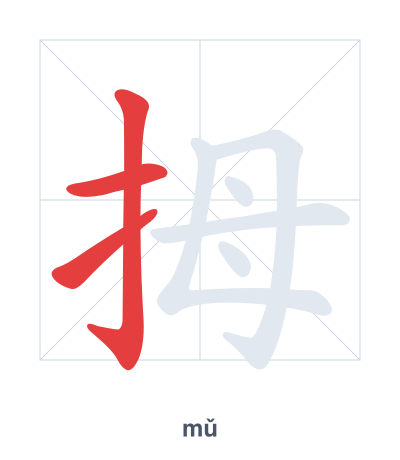
Open Hanzi Writer to see the animated stroke order and practice writing 拇 with real-time feedback.
The character 拇 (mǔ) is written with 8 strokes. Follow the standard Chinese stroke order: top to bottom, left to right, outside before inside. The radical 扌 is one of its key components.
Practice the correct stroke order with the Hanzi Writer app to see animated stroke-by-stroke guidance with real-time feedback.
拇 means thumb; big toe.
The character 拇 combines the hand radical 扌 with 母 (mother), suggesting the thumb is the 'mother' or chief finger of the hand. This phonetic-semantic compound highlights the thumb's role as the primary digit, essential for gripping.
💡 Memory Tip: Imagine a mother hen (母) perching proudly on a hand (扌), where her thumb-like beak leads the way.
他竖起了大拇指。
tā shù qǐ le dà mǔ zhǐ
He gave a thumbs up.
老师给了大拇指。
lǎo shī gěi le dà mǔ zhǐ
The teacher gave a thumbs up.
我喜欢弹拇指琴。
wǒ xǐ huān dàn mǔ zhǐ qín
I like playing the kalimba.
Open Hanzi Writer to see the animated stroke order and practice writing 拇 with real-time feedback.
✨ Animated stroke order · Handwriting recognition · HSK-graded practice · Free to use
The character 拇 has two parts: the radical 扌 on the left, meaning hand, and 母 on the right, which gives the sound mǔ. The hand radical shows that 拇 refers to a body part of the hand, and 母 (mother) hints that the thumb is considered the 'mother' or most important finger.