坶 (mǔ) means "soil; land" in Chinese. It has 8 strokes with the radical 土.
Rated 3.7/5 in difficulty (challenging).
Appears in 3+ common words including 坶妈 (mǔ mā), 坶地 (mǔ dì), 坶欧 (mǔ ōu).
Due to its 8 strokes, Hanzi Writer's error detection shows 坶 requires focused practice — most learners need 10+ attempts for consistent accuracy.
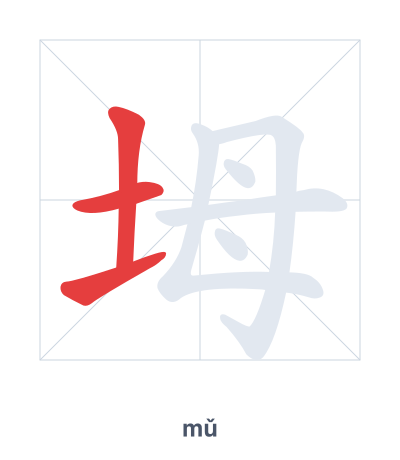
Open Hanzi Writer to see the animated stroke order and practice writing 坶 with real-time feedback.
The character 坶 (mǔ) is written with 8 strokes. Follow the standard Chinese stroke order: top to bottom, left to right, outside before inside. The radical 土 is one of its key components.
Practice the correct stroke order with the Hanzi Writer app to see animated stroke-by-stroke guidance with real-time feedback.
坶 means soil; land.
坶 is a compound character with the radical 土 (earth, soil) on the left and the phonetic component 母 (mother) on the right. The combination evokes the concept of soil as a nurturing 'mother earth' that sustains life, directly linking the visual form to the meaning of land or soil.
💡 Memory Tip: Imagine the soil (土) as a mother (母) cradling seeds, nurturing them into plants on her fertile land.
孩子们叫她坶妈。
hái zi men jiào tā mǔ mā
The children call her mother.
这里的坶地很肥沃。
zhè lǐ de mǔ dì hěn féi wò
The soil here is very fertile.
这是一个地名。
zhè shì yí gè dì míng
This is a place name.
Open Hanzi Writer to see the animated stroke order and practice writing 坶 with real-time feedback.
✨ Animated stroke order · Handwriting recognition · HSK-graded practice · Free to use
坶 is a semantic-phonetic compound. The left radical 土 (tǔ) means 'soil' or 'land', and the right part 母 (mǔ) provides the pronunciation. Together, the character carries the meaning of 'soil' or 'land', with the sound coming from 母.