茗 (míng) means "tea" in Chinese. It has 9 strokes with the radical 艹.
Rated 4/5 in difficulty (challenging).
Appears in 3+ common words including 品茗 (pǐn míng), 香茗 (xiāng míng), 茗茶 (míng chá).
Due to its 9 strokes, Hanzi Writer's error detection shows 茗 requires focused practice — most learners need 10+ attempts for consistent accuracy.
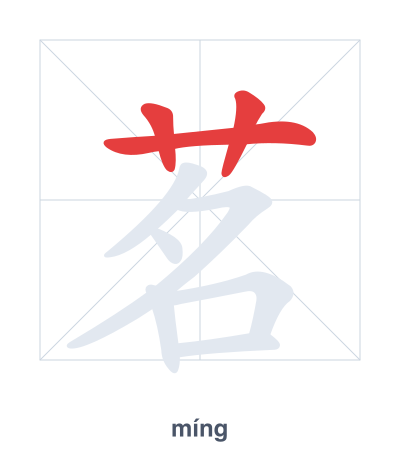
Open Hanzi Writer to see the animated stroke order and practice writing 茗 with real-time feedback.
The character 茗 (míng) is written with 9 strokes. Follow the standard Chinese stroke order: top to bottom, left to right, outside before inside. The radical 艹 is one of its key components.
Practice the correct stroke order with the Hanzi Writer app to see animated stroke-by-stroke guidance with real-time feedback.
茗 means tea.
茗 is a phono-semantic compound: the grass radical (艹) indicates it's a plant, and 名 (míng) provides the sound. It originally referred to the tender leaves of the tea plant, specifically late-picked tea or fine tea.
💡 Memory Tip: Picture a famous brand of tea (名) growing from grass (艹) – that's your premium 茗 brew.
我们去品茗吧。
wǒ men qù pǐn míng ba
Let's go enjoy some tea.
请喝一杯香茗。
qǐng hē yī bēi xiāng míng
Please have a cup of fine tea.
这里有很多茗茶。
zhè lǐ yǒu hěn duō míng chá
There are many types of fine tea here.
Open Hanzi Writer to see the animated stroke order and practice writing 茗 with real-time feedback.
✨ Animated stroke order · Handwriting recognition · HSK-graded practice · Free to use
茗 is made of the grass radical 艹 on top and the phonetic component 名 (míng) below. The grass radical indicates that this character relates to plants, specifically tea leaves. Together they form the meaning 'fine tea' or 'tea.'