湄 (méi) means "The bank of a river or lake" in Chinese. It has 12 strokes with the radical 氵.
Rated 4.2/5 in difficulty (advanced).
Appears in 3+ common words including 湄公河 (méi gōng hé), 水湄 (shuǐ méi), 湄 (méi).
Due to its 12 strokes, Hanzi Writer's error detection shows 湄 requires focused practice — most learners need 10+ attempts for consistent accuracy.
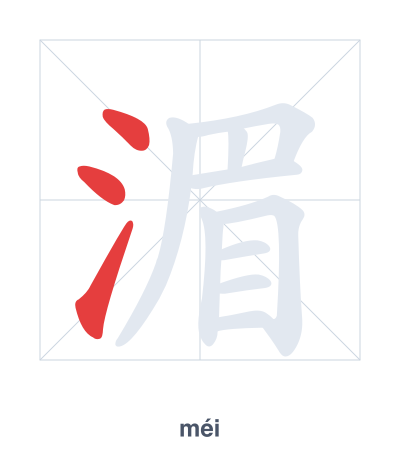
Open Hanzi Writer to see the animated stroke order and practice writing 湄 with real-time feedback.
The character 湄 (méi) is written with 12 strokes. Follow the standard Chinese stroke order: top to bottom, left to right, outside before inside. The radical 氵 is one of its key components.
Practice the correct stroke order with the Hanzi Writer app to see animated stroke-by-stroke guidance with real-time feedback.
湄 means The bank of a river or lake.
湄 is a compound character: the radical 氵 (water) indicates it relates to water, while the right component 眉 (eyebrow, méi) acts phonetically and also suggests the curve of a riverbank, like the arch of an eyebrow along the water's edge.
💡 Memory Tip: Imagine a river wearing a long, curving eyebrow (眉) along its watery (氵) edge—that's the bank (湄).
湄公河在亚洲。
méi gōng hé zài yà zhōu
The Mekong River is in Asia.
他在水湄散步。
tā zài shuǐ méi sàn bù
He is walking along the water's edge.
岸在水湄。
àn zài shuǐ méi
The bank is at the water's edge.
Open Hanzi Writer to see the animated stroke order and practice writing 湄 with real-time feedback.
✨ Animated stroke order · Handwriting recognition · HSK-graded practice · Free to use
The character 湄 is composed of the radical 氵 (water) on the left and 眉 (eyebrow) on the right. The water radical connects it to rivers or lakes, while 眉 suggests an 'edge' or 'bank,' just as eyebrows are at the edge of the face. Together, they create the meaning of a riverbank or waterside.