坴 (lù) means "clod of earth; high land" in Chinese. It has 8 strokes with the radical 土.
Rated 3.7/5 in difficulty (challenging).
Appears in 3+ common words including 坴坴 (lù lù), 坴地 (lù dì), 坴坶 (lù mǔ).
Due to its 8 strokes, Hanzi Writer's error detection shows 坴 requires focused practice — most learners need 10+ attempts for consistent accuracy.
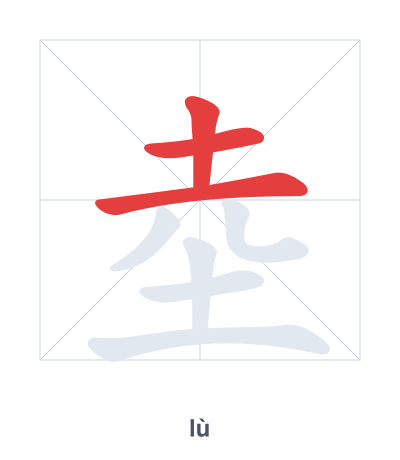
Open Hanzi Writer to see the animated stroke order and practice writing 坴 with real-time feedback.
The character 坴 (lù) is written with 8 strokes. Follow the standard Chinese stroke order: top to bottom, left to right, outside before inside. The radical 土 is one of its key components.
Practice the correct stroke order with the Hanzi Writer app to see animated stroke-by-stroke guidance with real-time feedback.
坴 means clod of earth; high land.
坴 combines the radical 土 (earth) with 圥, an ancient pictograph of a clod or mound. Together they emphasize a clod of earth or a raised piece of high land.
💡 Memory Tip: Picture a clod of earth (土) with a little mushroom-shaped hill (圥) sprouting from it, forming high land.
这里的土地很坴坴。
zhè lǐ de tǔ dì hěn lù lù
The land here is high and dry.
这里的坴地很平坦。
zhè lǐ de lù dì hěn píng tǎn
The high ground here is very flat.
这是一个古老的词语。
zhè shì yí gè gǔ lǎo de cí yǔ
This is an ancient term.
Open Hanzi Writer to see the animated stroke order and practice writing 坴 with real-time feedback.
✨ Animated stroke order · Handwriting recognition · HSK-graded practice · Free to use
The character has the radical 土 (earth) on top, which directly connects to the meaning of soil or land. The bottom part is a component that suggests elevation or a mound, combining to represent a clod of earth on high ground.